Tuesday, October 31, 2006

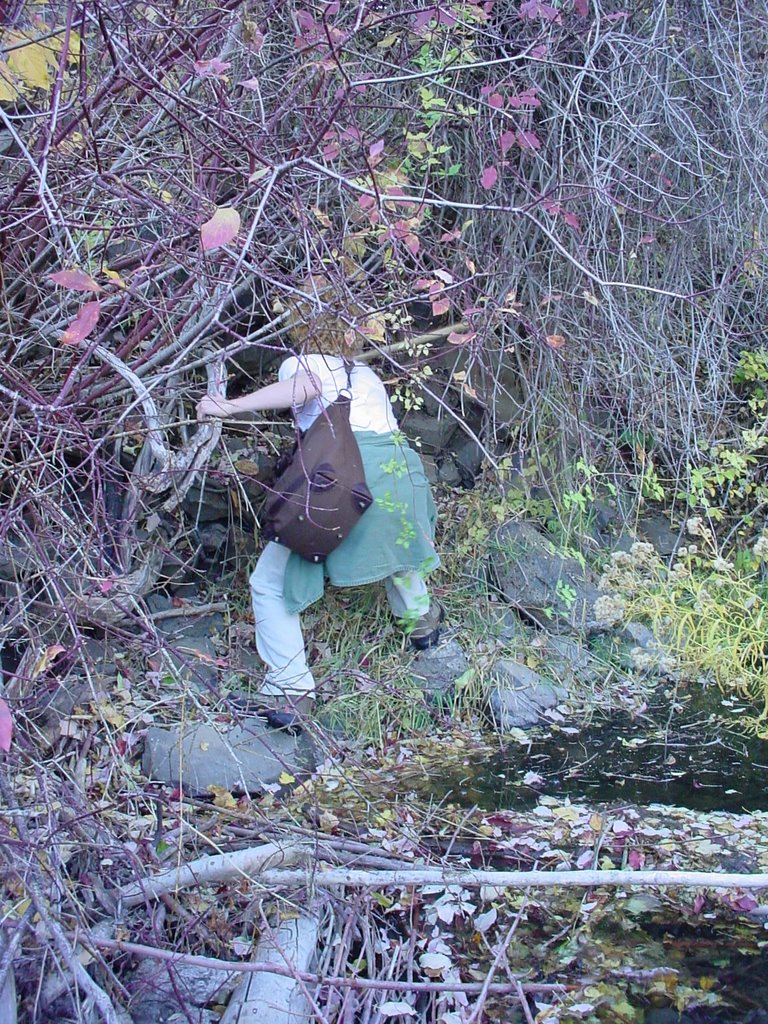
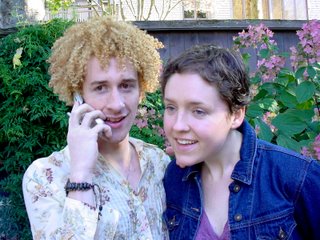
My son Taraz gave me this photograph on Sunday, taken on our trip. He said, "Go ahead and crop it. Do whatever you want with it, Mom." I decided to leave it as it is, him standing in the sunlight, on a most glorious autumn day. I offer these quotes, which are his favorite:

"The first effulgence which hath dawned from the horizon of the Mother Book is that man should know his own self and recognize that which leadeth unto loftiness or lowliness, glory or abasement, wealth or poverty. Having attained the stage of fulfilment and reached his maturity, man standeth in need of wealth, and such wealth as he acquireth through crafts or professions is commendable and praiseworthy in the estimation of men of wisdom, and especially in the eyes of servants who dedicate themselves to the education of the world and to the edification of its peoples.

They are, in truth, cup-bearers of the life-giving water of knowledge and guides unto the ideal way. They direct the peoples of the world to the straight path and acquaint them with that which is conducive to human upliftment and exaltation. The straight path is the one which guideth man to the dayspring of perception and to the dawning-place of true understanding and leadeth him to that which will redound to glory, honour and greatness."
~ from the Baha'i writings

The Subtle Consolations of War

Theodore Zeldin, in "An Intimate History of Humanity" says that humans have used three strategies to deal with their enemies: fight them, run away, or somehow manage to love them.

The problem with trying to destroy one's enemies , he says, is that it has become increasingly difficult to do so, despite the wonders of high technology. Another factor is that when wars are waged, the fighting can become an end in itself. War remains prestigious as the most dangerous of all excitements.

General Robert E. Lee confessed, "It is good that war is so terrible or else we would love it too much." He made it clear that the skills it demands and the thrills offered can be more important than the fate of the enemy. Zeldin writes, "Even unwilling conscripts, having suffered the terrible torments of the two world wars, have not infrequently looked back on them as the happiest years of their lives, because they found in war what they had searched for in vain in the monotony of their ordinary existence. When they put their lives at risk, they discovered how much they valued life, in its simplest form, much more than the vanities which accumulate around it. When they confronted an enemy they realised how precious a friend was. In the trenches and in moments of danger, comradeship could sometimes achieve the intensity of love, a sense of belonging, a comforting certainty that they would do anything to help those who faced the same perils as themselves, who would do the same for them, oblivious of all risks. Pride in joint achievements, eliminating selfishness and the jealousies of status, was sustained by a determination not to be unworthy of the life and death trust that each placed in his coleague. They had no choice but to transcend themselves, to reveal qualities they never suspected they had, to be more heroic, loyal, proud - even egalitarian - than they ever thought possible, to concentrate the mind so that no other worries troubled them but mere survival, not just for themselves but for those who had suddenly become brothers and who not long ago had been strangers. That at any rate was how some remembered war when its horrors ceased to be present, and they consoled themselves for their sacrifices with the belief that they had found a higher meaning in life, defending their nation or their principles. The brave felt bound together like a nobility, hating the cowards and malingerers in safe jobs away from the front line much more than the enemy. Humans have continued to fight wars not merely because they cannot agree, but even more because so many of them have loved the exhilarating sensations it created. Animosity against enemies has been a steadfast substitute for positive goals in life."

Monday, October 30, 2006

Exploring the Umtanum Recreational Area

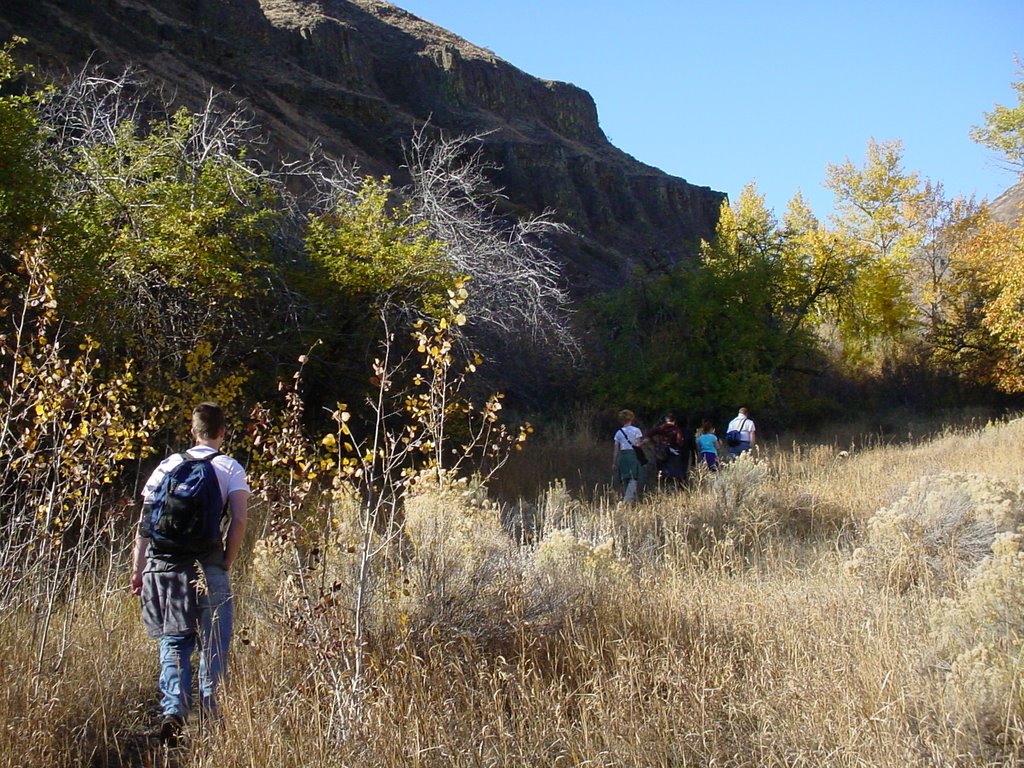
The family headed over to eastern Washington on the weekend, to do some hiking and exploring. We chose the Umtanum Creek Recreational Area, about a two hour drive from Tacoma. It's situated in the Yakima River Canyon, between Ellensburg and Yakima. It is a fantas- tically beautiful area, a geologic blend of desert hills and basalt cliffs that rise above the river. Our hike was along the base of the canyon, along a well-worn trail.

There were eight of us - Rue, Annie and Daisy; Taraz, Megan and their friend Alonzo, and George and I. We all wore our backpacks, containing a prepared lunch, and extra clothing for unpredictable weather.

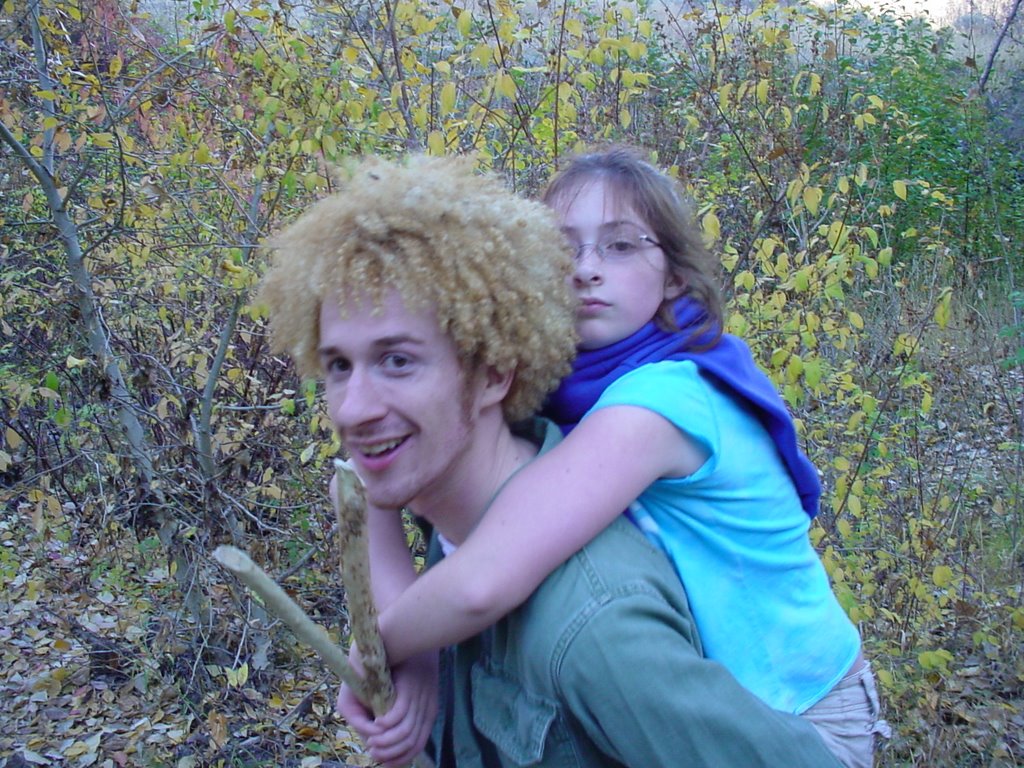
We hiked through groves of aspen, stands of cottonwood, and along a creek bed with beaver dams that required crossing. Although there is a dusty, well-worn trail through the valley, we took a few wrong turns and had fun bushwacking our way back through the underbrush. Taraz found some excellent sticks to help us clear an opening, and he showed us how to crawl through (me on all four, so my hair wouldn't get ripped on snags.)
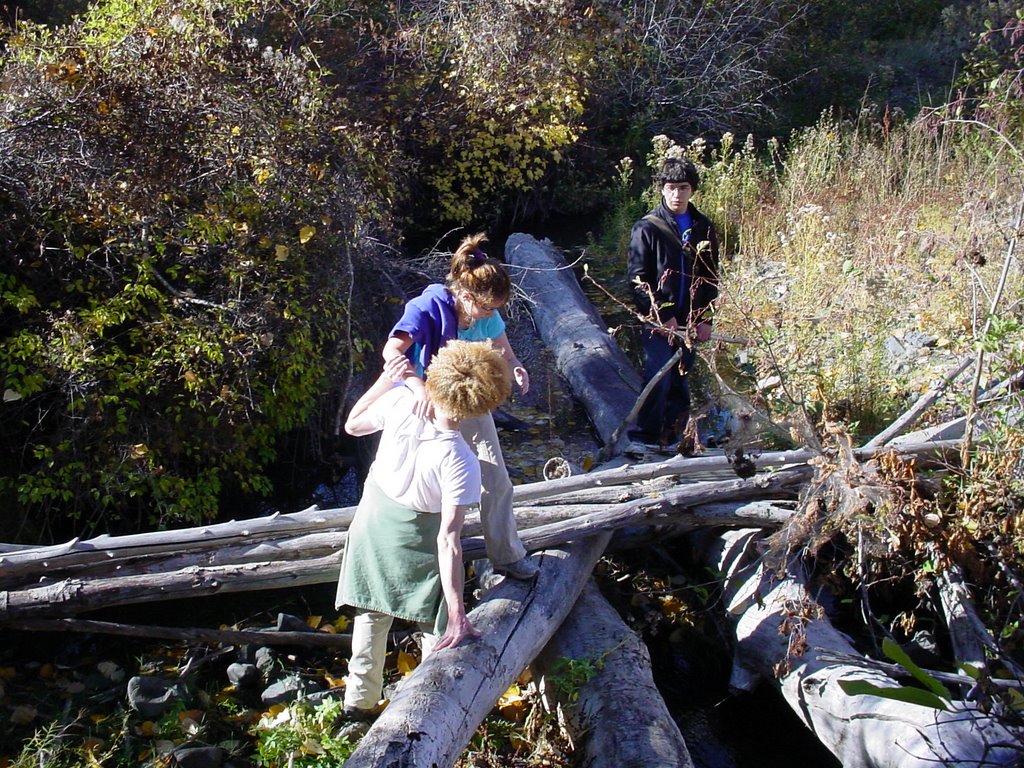
Daisy was a real trooper, doing quite well on the trails. But when we had to climb over and around some of the big logs, she begged for a little help, not sure of her footing. All of us used big sticks as props to get across some of the beaver dams, or to help pull one another up over an embankment.

Taraz was a delight to w
atch on this trip. He is like a kid, experiencing a place for the first time! He climbed up onto the high ridges, like a mountain goat. Nothing stopped him from getting higher and higher. Then he came crashing down through the shale moraine, sliding rocks, causing little rocks to tumble. When he comes here again, to climb the ridges in the spring, there is an excellent chance he can see bighorn sheep, mule deer, and elk.

We were clearly on 'the wrong trail' most of the 8 mile hike, obviously on an old trail that most hikers found discouraging, so it was poorly maintained. We eventually found a way over to a better trail on the way back, and had no problems hiking through the valley.

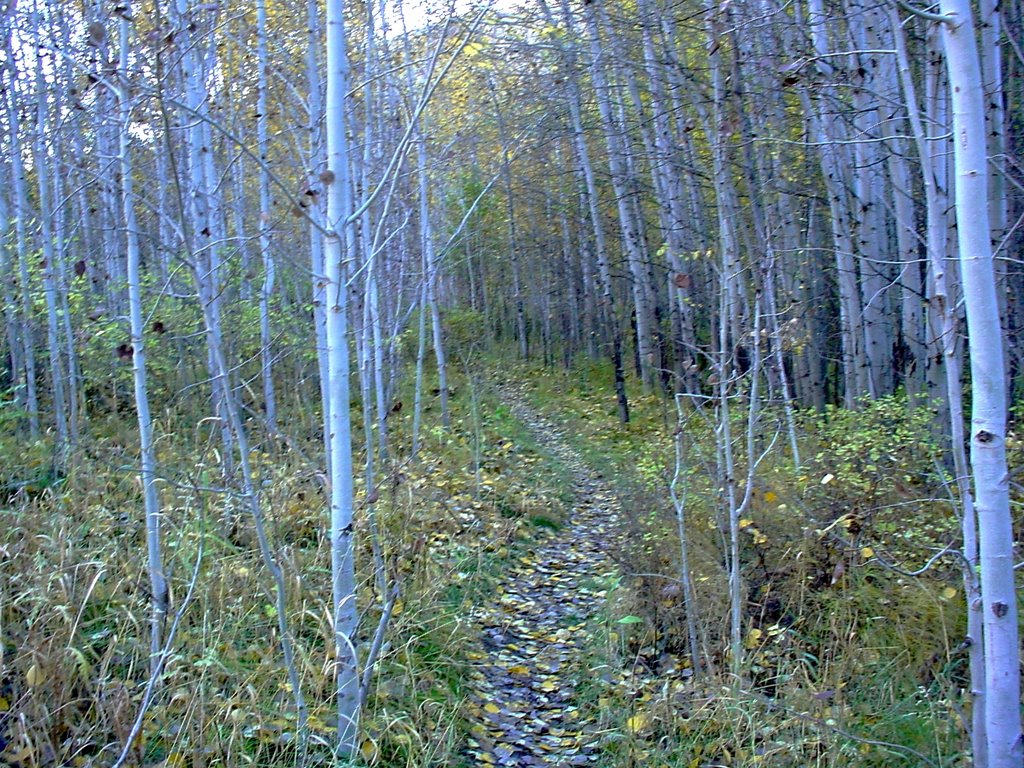
Meandering through this aspen grove was delightful.
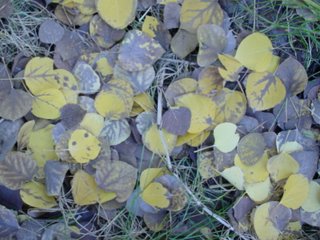
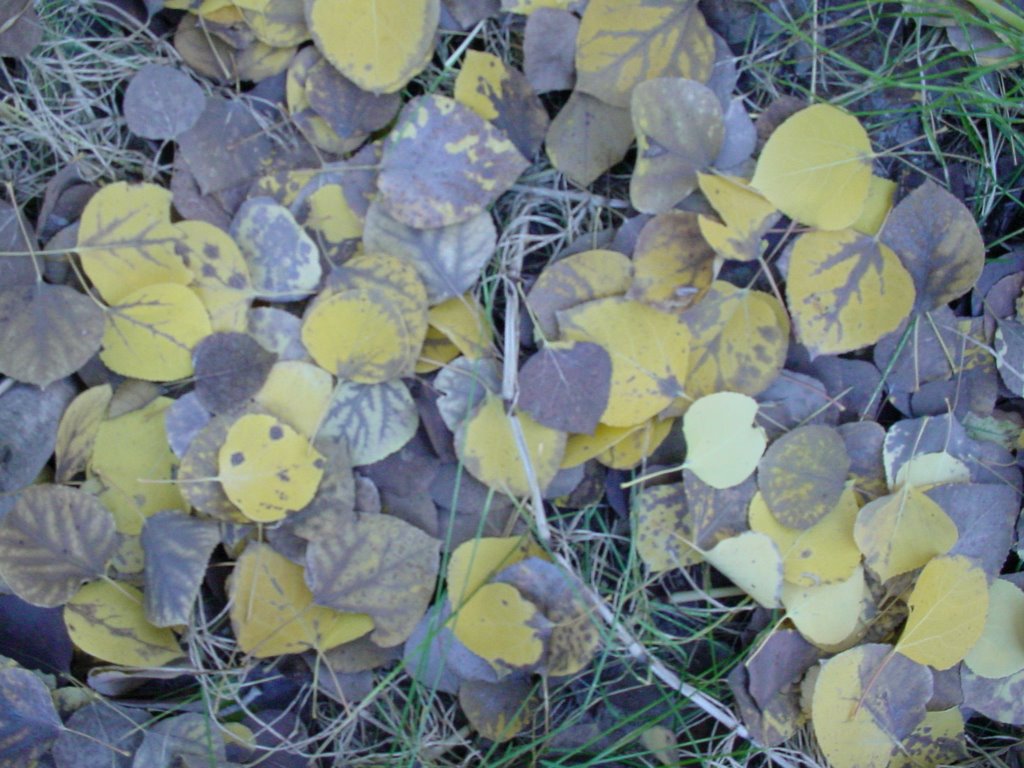
The leaves on the forest floor were in subtle shades of grey and light yellow. Along the trail, leaves that were still in the shade in the late afternoon still had frost skirting the edges (I've got photos, but they are blurry).

The folage on most of the trees were in brilliant colors, and all the desert plants were beautiful in the sunlight.

We stopped for lunch in a clearing in the forest, midway through the hike.

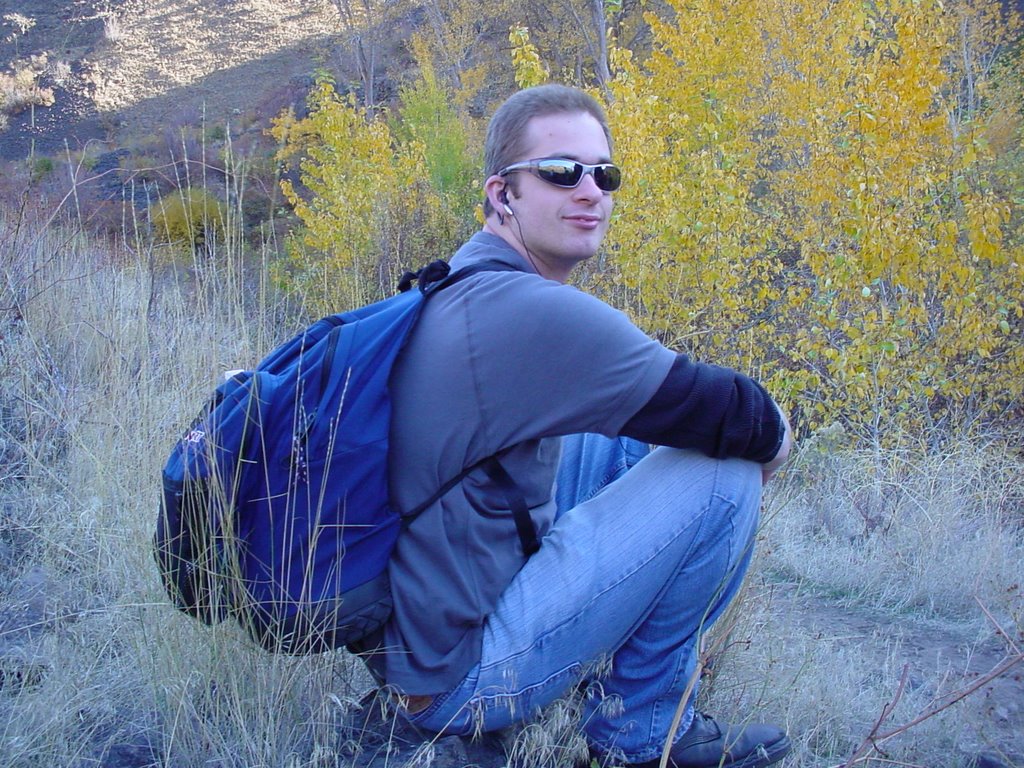
This is our son Rue. He was listening to music on his headset, bobbing his head back and forth.

And this is Taraz and Megan, arm in arm along the trail. I will say that this was one of the most enjoyable hikes I've ever experienced, primarily because I enjoyed watching all my kids have such a good time. I'm glad they like to get out into nature, soak up the sunshine, breathe the fresh air, and explore.

I have to laugh...the best part of the trip was getting 'lost', and working together to find the right trail, with everyone helping each other. I loved seeing the energy and enthusiasm, with everyone looking out for one another.

I'm very eager to come back to this location in the spring, and climb the far ridges along antelope trails. The view up there is incredibly spacious and wonderful.

Sunday, October 29, 2006


Friday, October 27, 2006

A rainbow trout fingerling peers out from the gullet of a northern pike at the Alaska Depart- ment of Fish & Game aquarium in Anchorage. More here.....the best photos of the year on "Immense World".

The Journey Home

Sandhill Cranes ~ by Jane Candia Coleman

We sit on the orange-striped couch,

the old woman in a purple dress,
her face a land of gullies, seams, erosions.

It's not the bowl I bargain for that's important.
What I need is the comfort of women talking.
the sound of words that matter.
What I want is forgiveness
for coming with dollars
to buy the spirit of her grandmother
walled in clay.

I tell her I have seen blackbirds
nesting in the cottonwoods.
heard the call of frogs
from the ruins by the river.
And she tells me the cranes flew over
crying long in the moonlight.

Now we are at ease with one another,
wrapped in the music of migrating birds,
in the spirit of the grandmother
who in her bowl left one line broken--
an open door she passes through.

Photograph by Michael Forsberg - check out his "Winter Images of the Plains"

The Rowe Sanctuary & The Iain Nicolson Audubon Center offers the world's largest concentration of sandhill cranes, located on the banks of the Platte River in southcentral Nebraska. Fall migration is in the air, with waterfowl numbers increasing steadily. Look for some late songbirds, shorebirds, and raptors.

National Public Radio ~ Watching Sandhill Cranes Make the Journey South: On "All Things Considered" host Debbie Elliott interviews nature writer Candace Savage in a field in Saskatchewan. Winter is approaching, and the sandhill cranes have begun their long flight south. As in the poem above, on adaptation, reconciliation and love, the sandhill cranes show their resiliance and adaptation - they've been around for over 9 million years!

Thursday, October 26, 2006

Walking Through Old Town - Tacoma

No, this photograph was not taken 70 years ago, when this little house was probably built. I took it yesterday when I was walking along a route in Old Town Tacoma, and I just happened to pass by. I've altered my walking route a little. George and I have been doing some of the hills in Old Town, as part of a 'workout' in the evening together - it gives us a chance to visit for at least an hour, and we enjoy the fresh air.

Most times, our walk is in total darkness, sometimes along cobble-stoned streets. I just know, as I walk along, that I will revisit the area, just to see what it looks like in daytime. I had the good fortune yesterday to bring my camera along as I walked along Carr, McCarver, Starr, and North 30th Street, my main route. I happened to notice that the Job Carr Museum was open, and Nancy Fishburne, the director, was there. She greeted me and we visited for about a half hour.

This is what the cabin of Job Carr looked like in 1869. He built the cabin on the south shore of Commencement Bay, living under a bark lean-to until it was completed. He founded the city of Tacoma, became its first mayor and post-master. When Job heard that the Northern Pacific Railroad planned to bring rail to Puget Sound, he determined to seek the ideal location for the terminus of the railroad. He found this location, and built his cabin. His grown sons, Anthony and Howard, and his daughter, Marietta, eventually joined him, coming from Indiana.

The little cabin that now serves as the museum was built after the fashion of Job's cabin. It has Carr family photos, original diaries and artifacts, period furnishings, early Tacoma history and memorabilia, rotating exhibits, and interactive activities. I took only a few images of the inside of the cabin, which I'll share in the post below. I hope to go back next week and really study the book of photographs, and take in a little more of the history.

Nancy gave me a few brochures to some of the other museums in our area - like a historian would! She was so congenial and enthusiastic. Sometimes, when you visit a museum, in spite of all the obvious delights, there is the memory of the caretaker, and it is this that is so memorable about my visit there. Had I known, when I was a child, that there was a 'job' working inside of a log cabin filled with history, I would have made that a childhood dream - one of the best jobs ever!

The Job Carr Museum in Old Town - Tacoma


Sooooo, you wanted apple pie.......

I used apples we found in the Duckabush Delta, and those little ones are quince, great for jelly.

I Wonder If This Is For Real!

(That is the question Oldeupher, my brother in law, asks, as he sends me this e-mail:)

The following questions and answers were collated from the SAT tests given to 16 years-old students!

Q: Name the four seasons.
A: Salt, pepper, mustard and vinegar

Q: Explain one of the processes by which water can be made safe todrink.
A: Flirtation makes water safe to drink because it removes large pollutants like grit, sand, dead sheep and canoeists.

Q: How is dew formed?
A: The sun shines down on the leaves and makes them perspire.

Q: What is a planet?
A: A body of earth surrounded by sky.

Q: What causes the tides in the ocean?
A: The tides are a fight between the Earth and the Moon. All water tends to flow toward the moon because there is no water on the moon and nature abhors a vacuum. I forget where the sun joins in this fight.

Q: What are steroids?
A: Things for keeping carpets on the stairs.

Q: Name a major disease associated with cigarettes.
A: Premature death.

Q: How can you delay milk turning sour?
A: Keep it in the cow.

Q: How are the main parts of the body categorized? (e.g., abdomen).
A: The body is consisted into three parts - the brainium, the borax and the abdominal cavity. The brainium contains the brain, the borax contains the heart and lungs and the abdominal cavity contains the five bowels, A, E, I, O and U.

Q: What is the Fibula?
A: A small lie.

Q: What does "varicose" mean?
A: Nearby.

Q. Give the meaning of the term "Caesarian Section"
A. The caesarian section is a district in Rome.

Q: What is a seizure?
A: A Roman Emperor.

Q: What is a terminal illness?
A: When you are sick at the airport.

Q: Give an example of a fungus. What is a characteristic feature?
A: Mushrooms. They always grow in dampish places and so they look like umbrellas.

Q: What does the word "benign" mean?
A: Benign is what you will be after you be eight.

Q: What is a turbine?
A: Something an Arab wears on his head.

Wednesday, October 25, 2006

In The Gloom Of Night

"Dost thou reckon thyself only a puny form......
When within thee the universe is folded?"
~ from "The Seven Valleys and the Four Valleys" by Baha'u'llah.

In the quiet darkness of night, we turn our eyes expectant and full of hope to the morn of God's grace.


This is a favorite prayer of mine, to be said at midnight: "O Lord, I have turned my face unto Thy kingdom of oneness and am immersed in the sea of Thy mercy. O Lord, enlighten my sight by beholding Thy lights in this dark night, and make me happy by the wine of Thy love in this wonderful age. O Lord, make me hear Thy call, and open before my face the doors of Thy heaven, so that I may see the light of Thy glory and become attracted to Thy beauty. Verily, Thou art the Giver, the Generous, the Merciful, the Forgiving."
~ Abdu'l Baha, Baha'i Prayers
~ Artwork by Joseph Farquharson

Boosting The Morale of American Troops

I received an e-mail from my daughter, Ruhiyyih, enclosing this photo of Sgt. Mike Davis in Iraq holding up a photograph of my children! He had just received a couple of care packages from Ruhiyyih, filled with cookies! Sgt. Davis runs a coffee shop in Mosul in his spare time, to help boost the morale of American soldiers there. He uses his own resources to manage it, and he was happy to get the packages of home made cookies from Ruhiyyih.

Brad Brauser, a civilian working in Iraq, took the photo, and e-mailed this message to her: "I passed along your care package for Sgt Davis with the Coffee Shop. He saw me drive up, and walked out to meet me. As I exited my truck with your boxes, he said, 'ok..let's do this fast', because if he stops to think about what you and those like you have done for him, he gets misty eyed very fast! I laugh at him when he does it...and it brings him around. So he was kind enough to stop and take a picture with your special box for him, and I also gave him your small cookie box! The soldiers outside the shop on the patio came running when he said, "home-made cookies!". He's really a great man, and does spend his share of time outside the wire in harms' way, as well as running his coffee shop / nighttime steak / barbecue pitstop for the soldiers."

Ruhiyyih found Brad's website,
"Supporting Troops", wrote to him, and he found a way to get the cookies over to Sgt. Mike for the coffee shop. The end result is a group of happy people, and an astounded mama! Little did I know that when we took those wedding photos of our children on September 16th, that a copy would be in the hands of a U.S. soldier over in Iraq. It makes me realize how small the world is, how everyone seems like a part of the human family, a family we care about.

I thought of the long hours of Brad Blauser, his dedication to the spiritual wellbeing of those caught up in war, and I felt grateful that he has dedicated this part of his life to such noble service. He writes:

"For those who don't know, I'm on a military base in a combat zone. Civilians and soldiers work everday, with civilians working 12-13 hours/day. One cool thing for me is to have the chance to hang out with the troops in the off time. I'm involved in a couple of different projects I started - Wheelchairs for Iraqi Kids and Study Bibles for Soldiers. Yep, I'm an man of faith, and feel I've been placed here to help the troops who are seeking answers to eternal questions, since the foxhole conversions manifest themselves frequently during times of war and uncertainty. I'm here to help the guys who have questions get answers to their questions, and nurture them along in their faith as young Christians for those who choose the path."

I feel grateful that my daughter spent her time and resources to reach out to those who struggle so far away. She has sent out about 8 packages now, and one of the recipients, a woman, e-mailed a video of herself receiving the gift, with a 'thank-you'. It amazes me that all of this can be done over the internet, so instantly. Our ability to communicate, to show gratitude and thanksgiving is instant, with a photo or a video.

William S., pictured below, also e-mailed Ruhiyyih. He
wrote: "I visited the chapel services at Mosul, Iraq yesterday and was delighted to receive a package of delicious, home made chocolate chip cookies with your name on them. That was very thoughtful of you to do that for the soldiers and even though I am a civilian working here, I ate them and enjoyed them very much. I am a safety instructor for KBR, a large civilian contractor who provides many services for the soldiers (laundry, food, billeting, electricity, drinking water, etc., etc). I met Brad Blauser several months ago at another base (Tikrit) when he was a student in my class and was delighted to run into him again yesterday at chapel in Mosul. I am from Oklahoma where my wife and I still maintain the home where we raised our 5 grown children. Of course they are scattered to the winds now, but we are looking forward to being together in Oklahoma for Christmas. There is an old Christian monastery from the 5th century inside the Mosul military compound and my safety class went there for a field trip to do a safety inspection and take our class picture. That is me standing in the middle of the group wearing a red shirt."

"I am so proud of our soldiers here who put their lives on the line every day to try to help Iraq build a society built on peace, freedom and democracy while others oppose them who want to build a society built on death, fear, hatred and violence. These soldiers hear so much news on CNN and BBC that their sacrifices are pointless, futile and misguided. They really need to know that there are people back home who support them, love them and honor their efforts. I am delighted to be able to hear from one of them and to enjoy her cookies."

Additional link: Adopt a Chair - provides wheelchairs and other mobility products for people in developing countries without regard to political affiliation, religious beliefs or ethnic identity.

Tuesday, October 24, 2006

Snake Lake Nature Preserve

Last weekend was such a glorious sunshiney event, unlike the preceeding days of rain and fog. When George told me he had an 'all day meeting' on Sunday, I figured I'd be spending most of the day inside by the fire, with a good book (and I've got one!). But, Sunday emerged quietly, with a silver blue sky, and then it burst into brilliant sunshine. So, how to spend the day... I put my book down, straightened the house and went for a long walk over to the Snake Lake Nature Center.

This little refuge is about a mile from my home, and is a wetland grotto right in the middle of the city. On one side of it there is a freeway overpass, where the traffic surges by at frantic speeds. On the other two sides of it are busy city streets with four lanes of bustling, noisy traffic. One would not think that a few hills and forest, some spongy wetlands with wood ducks and red-winged blackbirds, and a cement trail would be nestled in all this urban clutter. But, someone thought to preserve it, and should you walk far enough along the trail, with its wooden markers pointing out tree specimens, you will find that even here there is the opportunity to observe and wonder.

Quite a few cars in the adjacent parking lot indicated that others thought this was a neat little place too, for an hour's repast. I noticed a father and his son gathering information about trees, with a school paper at hand, to be filled out by the student. Patiently, they turned leaves over and examined berries, in hushed voices, and placed a few specimens in a bag. Another couple walked by, she still in her nursing uniform. I suspect she was on her lunch break, mid-day, and that he was her husband, coming to escort her away for a pleasant interlude. Park Rose Care Center is across the street, and when I worked there, I sometimes did this very thing to get a breath of fresh air on my break.

Since the nature preserve is small it discouraged one man who came wearing hiking boots and carrying a large backpack. He was walking ahead of me, starting briskly, perhaps hoping for some adventure. But, within a few blocks he turned back. This place was too small. At the entrance of the preserve I noticed an old woman sitting on a park bench while holding her small dog. Since pets are not allowed on the trail, she could only sit there at the entrance, and enjoy the sunshine. She had a sack lunch, and was content just to watch the visitors arrive and enter the forest, then return from their excursion. Mothers came with children and babies in strollers. A few high school boys jostled noisily through, and I came with my camera. The old woman seemed quite at home, enjoying this remote companionability.

It was not a good time to photo- graph anything. The light was too brilliant, so I focused my eyes downward, toward the leaves covering the trail. Walk far enough, and the cement turns to hardpacked dirt and pine needles, then a trail through the forest. All the deep shades of color have now washed out and dried up. Under my feet there was the crunch of dry leaves, then a wisp of dust. At the little pond dust lay in a film across the water, and all the aquatic plants were brown and soggy. Even the vegetation along the pond's edge was crisp and brittle.

I walked along an old bridge across the pond. Metal pipes were braced against the left side, holding the walking platform level. The posts were undergoing repairs, and plywood covered rotting boards. At one end of the nature preserve the highway was under repair, and sandbags and tarps had attempted to divert a portion of the little stream creating the pond. I thought how abrupt and unsightly all these modifications were, quite a nuisance and out of touch with the natural flow of things.
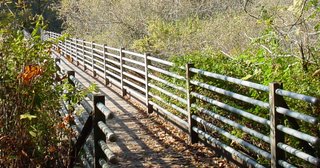
I wonder how Snake Lake will look in the spring. Will the repairs be completed? Will the wood ducks and mallards return? Will the old woman sit by the entrance with her dog, and enjoy watching the enthusiasm of the children walking the pathways? I walked home, and since the day was so beautiful, I worked outside in my garden, pulling up the remainder of my tomato plants and composting the spent dahlias. It is the end of the growing season, and already I wonder about spring.

Monday, October 23, 2006


What else did you expect on a Monday morning?


~ Maxine

A Joyful Family Gathering

Taraz and Megan were honored at a wedding celebration this weekend. It included about eighteen family members, friends from Megans work, members of the Baha'i community, and some old, dear friends from Taraz's childhood.
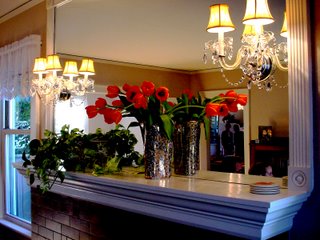
It was held in Megan's parents' home, in the historic district of Tacoma. The house is one of those early finely-crafted homes that aren't made anymore, with the superior attention to architect- ural details like special intricate moldings, a spot of mosaic marble on the floor, and enchantments in every room.

I will have to admit that I didn't take many photographs, but rather used my video camera most of the afternoon, capturing all the friends and family as they mingled in different rooms of the home and out in the patio.

This lovely older home has three 'living rooms', one large formal one with a fireplace, another that seems like a parlor or sitting room looking out onto the backyard garden, and another that is like a den right off the kitchen. People sat and chatted everywhere, even downstairs in a large media room where Taraz showed his video of the wedding. A long divan was against a wall, and families and children took their refreshments down there.

Megan's fraternal grandparents, Allen and Sarah, caught in a relaxed moment at the end of the day when the gathering had subsided, are as gracious and friendly as they appear here. (They would like Megan and Taraz to spend Thanksgiving with them this year, and asked if that would be O.K. I encouraged it, as we have indefinite plans for November - George and I want to fly to California to visit his brother and I'd like to visit my sister Bonnie sometime in late November.)
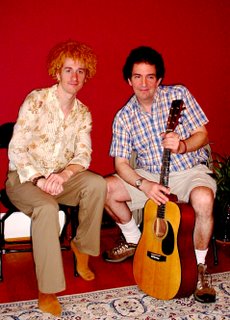
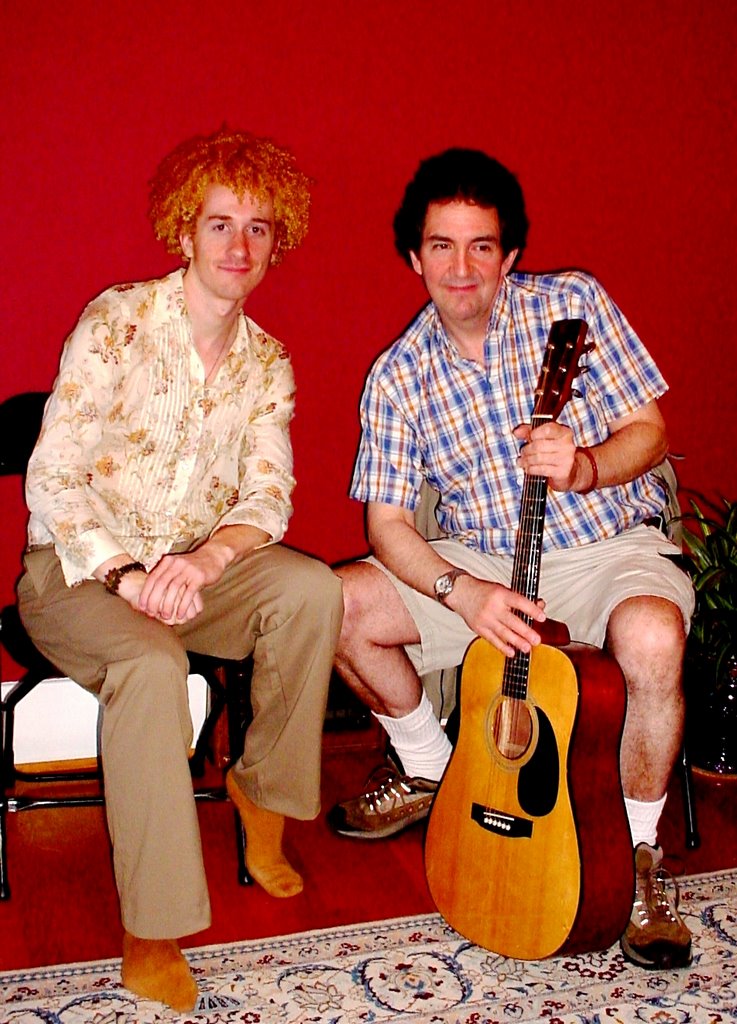
This is Chris, a friend of Taraz's. He works as a musician in our community, leading 'open mike' in some of the coffee-houses and clubs. He played folk music while friends and family looked through the 'wedding album', finding their favorite memories.
And this little guy did not want to go home with me, in spite of all the little squeezes and conversations we had. He was simply precious, and I would have easily assumed all the challenges of motherhood once again had he done so. But, balloons and his big brother became a major distraction, and our conversation came to naught. He had the most cheerful disposition, and I must admit that a significant amount of my videotaping involved following him around. He is about a year and a half old, and had not seen such a magnificent stairway as was presented by the one down to the media room. I couldn't help cheering him along, as he surmounted each step, then challenged by the next one, alternately frustrated or delighted in the process. I thought the attitudes he brought to that endeavor is what is really required in marriage. It is a matter of learning how to negotiate all the little steps that provide healthy patterns and stability. It requires re-working and re-examining, learning the art of careful thought and conversation. As I watched Taraz and Megan, I noticed that in the short month that they've been married, Megan has become even more beautiful, and Taraz is learning .....to listen! I told him, early on, to be a good listener, as oftentimes in conversations a woman just wants the comfort of dialogue. Some men want short conversations, with the thought being to solve problems quickly. There are significant differences in the tone and intent of both approaches.

When I came home from our family gathering, I continued reading "An Intimate History of Humanity" by Theodore Zeldin. He writes a fascinating chapter on loneliness and how people devise strategies to confront it. He says that everyone needs small doses of diverse relationships, that in order to survive side by side with others it is necessary to absorb a minute part of others, and that curiosity about others is essential to one's very own existence. He shows how the world is not just a vast, frightening wilderness... some kind of order is discernible in it, and that the individual, however insignificant, contains echoes of that coherence. He writes:

"People who believe in some supernatural power have their loneliness mitigated by the sense that, despite all the misfortunes that overwhelm them, there is some minute divine spark inside them: that is how they are immunized. Those who have no such faith can develop a sense of being useful to others, and can recognise a link of generosity between themselves and others, rational and emotional connections which mean that they are part of a wider whole, even though they may be unable to decipher fully its enigmas and cruelties. Much of what is called progress has been the result of solitary individuals saved from feeling totally alone, even when persecuted, by the conviction that they have grasped a truth, a fragment of a much wider one too large to capture. "
Friday, October 20, 2006

A Shelter In The Storm

This is the view out of a little walkway on the campus of the University of Puget Sound. A light rain and a bit of fog kept me company. Most of the students were in class, and far off, in the bell tower, a solitary chime announced 3:30. It was a blissful afternoon!

History Written From A Different Perspective

I'm reading "The Intimate History of Humanity" by Theodore Zeldin. One interesting tidbit, a substantial hope, which will make for good reading:

"What we make of other people, and what we see in the mirror when we look at ourselves, depends on what we know of the world, what we believe to be possible, what memories we have, and whether our loyalties are to the past, the present or the future. Nothing influences our ability to cope with the difficulties of existence so much as the context in which we view them; the more contexts we can choose between, the less do the difficulties appear to be inevitable and insurmountable. The fact that the world has become fuller than ever of complexity of every kind may suggest at first that it is harder to find a way out of our dilemmas, but in reality the more complexities, the more crevices there are through which we can crawl. I am searching for the gaps people have not spotted, for the clues they have missed.

Thursday, October 19, 2006

Bloomin' Late

Poems by Denise Levertov


When Denise Levertov died in Seattle in 1997, she left behind 40 finished poems in a loose-leaf notebook. She was born in England, but came to appreciate her home in the Pacific Northwest. The first poem is about an early spring day, and the latter about the fog that now shrouds our early autumn mornings....

Brilliant,
this day – a young virtuoso of a day.
Morning shadow cut by sharpest scissors,
deft hands. And every prodigy of green –
whether it's ferns or lichens or needles
or impatient points of buds on spindly bushes –
greener than ever before. And the way the conifers
hold new cones to the light for the blessing,
a festive right, and sing the oceanic chant the wind
transcribes for them!
A day that shines in the cold
like a first-prize brass band swinging along
the street
of a coal-dusty village,
wholly at odds
with the claims of reasonable gloom.


Settling

I was welcomed here—clear gold

of late summer, of opening autumn,
the dawn eagle sunning himself on the highest tree,
the mountain revealing herself unclouded, her snow
tinted apricot as she looked west,
Tolerant, in her steadfastness, of the restless sun
forever rising and setting.
Now I am given
a taste of the grey foretold by all and sundry,
a grey both heavy and chill.
I've boasted I would not care,
I'm London-born.
And I won't. I'll dig in,
into my days, having come here to live, not to visit.
Grey is the price
of neighboring with eagles, of knowing
a mountain's vast presence, seen or unseen.

~ Denise Levertov ~ from "The Great Unknowing: Last Poems"

The Writing of Poetry by Denise Levertov

(This speech was published in her 1981 prose collection, "Light Up the Cave". )

I was asked to talk about the life of a poet. Some of you will not find poetry at the very center of your lives though no doubt it will go on being a profound resource--both writing it and reading it. Others will find that it is indeed a dominant force in their lives--it has been for me. I started very young. The primary impulse for me was always to make a structure out of words, words that sounded right. And I think that's a rather basic foundation of the poet's world.

Of course, one also is motivated by the desire or need to "express one's feelings"--and it is essential that the poet has something he or she passionately wants to say--or rather, to sing, since poetry is closer in its essential nature to music than to expository prose. But without the impulse to make a thing out of words, as a sculptor makes a freestanding thing out of clay or wood or stone, a poem will remain only self-expression. Poetry is an art, not a form of therapy, and if a person with a love of poetry, a love of language, recognizes this early, it helps. Because then that person's natural gifts will be put at the service of the art, instead of the art being put into bondage and utilized as a "vehicle" for opinions or emotions. The arts are not vehicles, they are not like bicycles or bomber planes!

You just plunge in, not knowing what you're doing, and find that you've done something, made something. It's exciting and encouraging to take oneself by surprise like that. But even a strong talent needs nourishment: don't ever feel that if you read other people's poetry you'll lose your originality. You have to trust it--your talent. If it could be so easily destroyed it wouldn't be worth much anyway. It's useful to be influenced--after a while an influence will be absorbed into your own style. Read widely and deeply. But also use your eyes and ears. Try to avoid vague general statements about your feelings, and instead practice accurate description of things you see. You will find that because you are seeing them through your emotions, as if through tinted glass--blue or rose!--the way you evoke a picture of your street or your friend or the sky will convey more about your feelings than any statement can. And thus another person reading it will feel what you feel instead of just being informed about how you feel. When one discovers that one has a gift for writing poetry it's a solemn and also a deliriously exciting moment. Maybe many moments--because sometimes you don't believe it and then you discover it over again. One feels chosen--and if one has an adequate recognition of poetry being something larger than oneself, one feels a sense of dedication to the calling of poet. It's a secret feeling and you don't have it all the time, but it's there. And because of this dedication a poet learns to revise, to work at his or her poem until it is as perfect as it can be. Not in order to show off, to compete with others, to demonstrate personal cleverness, but for the sake of poetry itself. You can't make a poem happen, but once it begins to happen you can help it become complete. It's a little bit as if the poet were a sort of photograph developing medium, which makes the mysterious hidden image appear from the negative and become clearer and clearer. (You've probably watched a Polaroid photo appearing as if by magic while you look.) This task of working at and with the poem is what really grabs one.

I think the people who go on writing all their lives are those for whom that process is itself utterly fascinating. For the poet, not having written a poem, but the experience of writing it, is what matters. And somehow, if your gift goes on growing and making its demand on you, you will try to find the ways of living that will be most suitable for you as individuals to go on doing your work in poetry--you will find your talent giving shape to your lives.

Wednesday, October 18, 2006


I'd intended to photo- graph the Cherry Cheese- cake Pie I made, but I forgot!
On The Home Front

I received an e-mail from Annie's mom, with photo- graphs of Annie and others sewing Christmas stockings for our soldiers abroad. Many of the ladies (and some children, including my grand-daughter Daisy) were engaged in this service project, no doubt happy that they were supporting the war effort. They'll be stuffing the socks with personal care items, food, inspirational words, and small toys the soldiers can give to the Iraqi children. The items are specifically for Gabriel DeRoo's unit, as a holiday remembrance from the members of his church.

Over the years, and through generations, women have lent support to war efforts in America. It has perpetuated a history of its own, replete with all kinds of service projects, conservation of resources, victory gardens, and penny-pinching for fund raising.

In the early part of this century, most married women still remained at home, where they managed the household and the family budget, and were influential decision makers. Before the First World War, advertisers often targeted female consumers, while during the war, public campaigns to conserve scarce resources or raise money were often directed at women. Civic and religious organizations pursued ambitious reform agendas, sought improvements in education, and ran campaigns against alcohol. Women's wartime activism included service in the Red Cross and the Young Women's Christian Association (YWCA).

During World War II, thousands of average housewiv
es diverted part of the family budget to buy war bonds. They learned how to save precious cloth and conserve food. Some women also took on new jobs and responsibilities temporarily vacated by men. Remember the stories about Rosie-the-Riveter?

Katie Grant was one of those women, working in the shipyards of California during the Second World War. Her husband Melvin joined the Marines and was shipped overseas. She writes, "I worked the graveyard shift 12:00 - 8:00 a.m, in the shipyard. I took classes on how to weld. I had leather gloves, leather pants, big hood, goggles and a leather jacket. They said you weld like you crochet. Well, I did not know how to do that, but I could sew and make a neat stitch. We held the welding rod with one hand and the torch fire in the right hand. Placed the rod in a seam and melted it down in a small bead seam and brushed it off with a steel brush. They put me forty feet down in the bottom of the ship to be a tacker. I filled the long seams of the cracks in the ship corners full of hot lead and then brushed them good and you could see how pretty it was. The welders would come along and weld it so it would take the strong waves and deep water and heavy weight. I liked it pretty good. I don't remember how much I got paid for working. Lots of people came to Richmond to work in the shipyards. Lots of women went to work to help with the war. I told (my husband) Melvin later that I helped to make a ship for him to come home in."

However, most of women's war work was confined to tasks that fit within their idealized roles as mothers--nursing troops, sewing bandages, and conserving food. Because men were away fighting the war, it was up to the women on the homefront to coordinate the effort to raise money for the war and to produce and conserve important raw materials.

The First World War's greatest contribution to the nationwide women's movement was in helping to create new attitudes toward the role of women in public life. This helped secure the passage of the Nineteenth Amendment to the U.S. Constitution in 1920 granting white women the legal right to vote.

(Resource: Robert H. Zieger, "America's Great War: World War I and the American Experience")

Posters, University of North Carolina archives

Tuesday, October 17, 2006

My Neighborhood - 6th Avenue

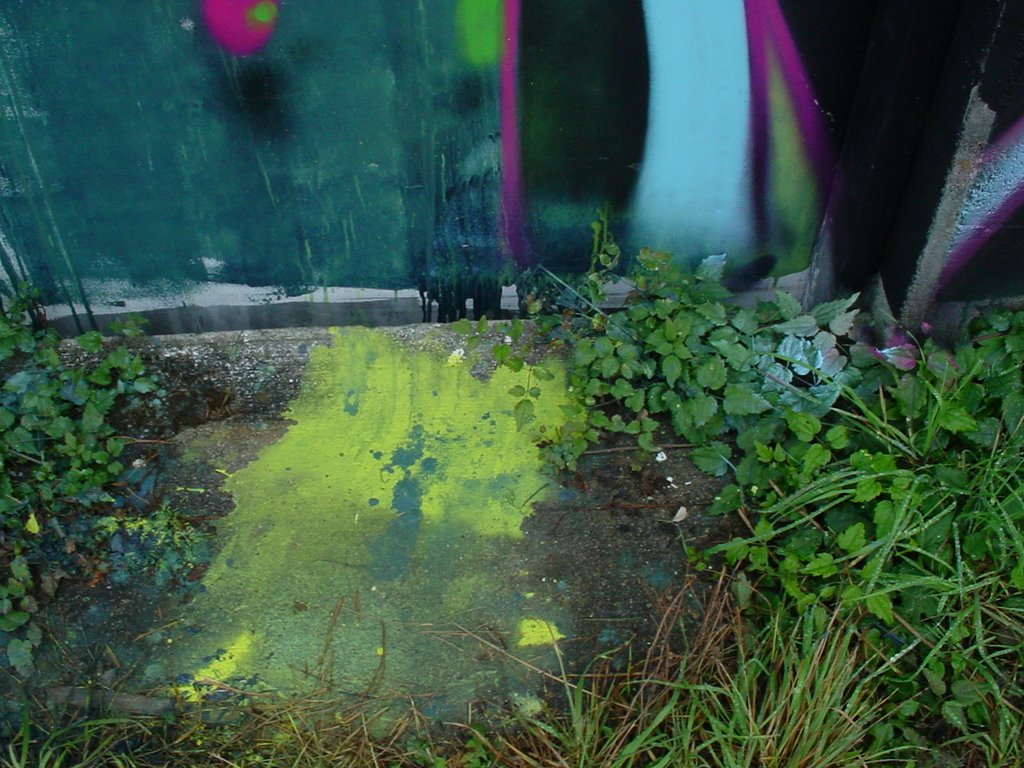
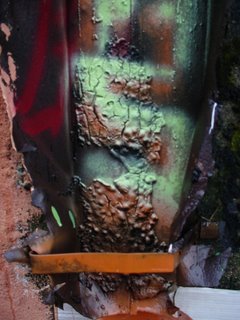
You are surely wondering what this ghastly goo is, and why I'd stop to take a picture! Actually, it is old paint, on a rainpipe in the alley near a shop on 6th Avenue, in the North End of Tacoma.

I've been walking along this main thorough- fare, which encom- passes the Proctor District, the University District, and the historic Stadium District as part of my weekly routine.

When I moved to Washington from a small town in Montana, I was not at al
l delighted living in Tacoma, with shopping districts, a lot of traffic and congestion, and the bustle of the city. But, here I am, and 18 years later I can say that I've made myself at home. Instead of walking through prairie grass or along a country trail on the look-out for cougars and bears, I'm walking along city streets - in my hiking boots. I put on a faded black visor, tie my long curly hair at the back with a scarf, and wrap a plaid flannel shirt around my waist. I'm heading down my mainstreet - 6th Avenue, just a few blocks from my house.

It is a main street that leads from the water of Puget Sound over to the railroad tracks and the industrial Port of Tacoma, with its container ships in Commencement Bay. I walk about two miles, looking in shop windows, browsing the bead shops, the cookware shops, the deli's and the art galleries.

It is a famous street for eateries, like Primo's Grill, Silk Thai, and Southern Kitchen, one of our favorites: listen to this, " Probably the last restaurant in Western Wash- ington with a screen door, the small but com- fortable Southern Kitchen cradles its regulars: college kids, families after church, old folks, everybody. Gloria and Thad Martin bought the place in 1994, and have been slathering their customers with love and country gravy ever since. "

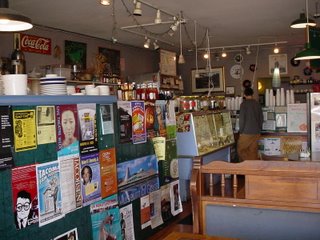
There's Gateway to India, and Shakbrah Java, a little soup and sandwich eaterie with a lot of little tables along a wall of books. Reading and lingering over coffee is incouraged. It is a hangout for gatherings, and clubs, "where more than fifty leaders and activists from Western Washington's progressive organizations gather to discuss current efforts to identify ways they can be a driving force for change in their community. The Steelworkers Tacoma/Pierce County Associate Member Chapter bring together peace groups, retired and working union members, Demo- cratic and third party activists, GLBT groups, professors, and many others...."
Jazzbones Restaurant and Nightclub. is a real hotspot on 6th Avenue, offering nightly live music and an open mike. Once a month a guest artist comes in with canvas and paint, and patrons help him create a painting. Everyone pitches in, contributing concepts and suggestions. He completes the work, and it is sold to help fund projects at Jason Lee Middle School a few blocks away. I was reading posters on the front door, when one of the proprietors saw me, opened the lock on the front door (the place wasn't open yet), and asked if I'd like to look around. He invited me in, showed me the art gallery upstairs, and the stage below. In November Jazzbones will open at 11:00 a.m. for lunch. That will bring in more of the day crowds who frequent 6th Avenue.
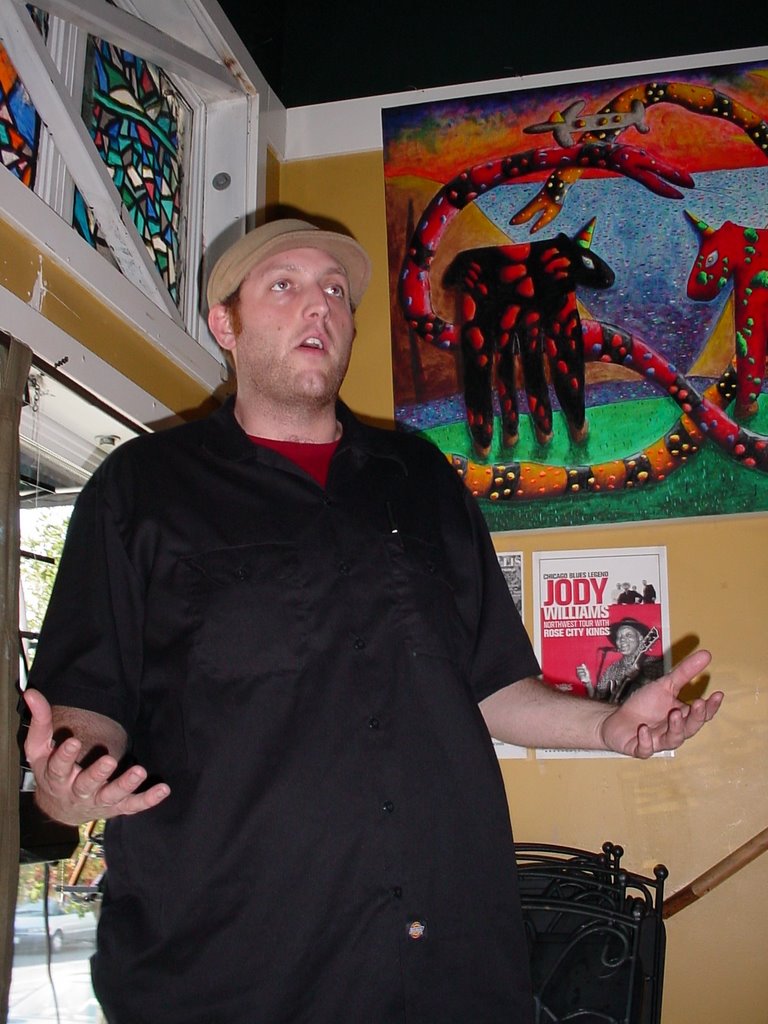
This is one of the posters I was looking at, on the doorway. A gentleman came up to me and saw my camera, thinking it must be a very fancy, high-faluttin' type cause it is so big. He asked a few questions about it, and I told him it was a very old Sony model, a beginners type, that was sold 5 years ago.

I enjoy a real sense of community walking along the sidewalk, and people - amazingly - greet me, like the young man at the signal light who leaned out the window, and said, "Hey lady! I like your hat!" I smile a greeting, and he watches me pass. Another man acts silly in front of an espresso cafe, hugging his friends as he walks out. He sees me and says, "I'm here to give anyone a hug...do you want a hug?" I smile, keep walking and say, "I'll think about it." I watch his friends roll their eyes in amusement and pull him toward their car.

Another lady, the owner of Caravan Dreams, looks a
t me appreciating her dolls in the window, and comes over. The door to her shop is wide open. "Do you want to come in? I'm just about ready to close..." The aroma of incense was drifting out the doorway. I told her "No, thanks, but I'll stop by in a day or two on my walk."

As I walk along, I notice that someone has put a lot of attention into the grating around a tree in the bullevard.
Grafitti covers an art gallery wall in the alley.

And, the painter even left drops on the tiny plants near the pavement.
Long ago, this paint covered a wall and a handle. I like how parts of it show what's under- neath.
And, this little guy, he really caught my attention. I walk past a funeral home, a ballet studio, a Greek take-out place where the aroma of gyros and pizza drifts out onto the sidewalk. There is an animal hospital, a pottery workshop, a Baptist church, a lawn mower repair, a denture repair, a lawyer and an accountant, and a Starbucks. Taco Bell, Kentucky Fried, Teriyaki, a hair and nail salon, Bartell Drug and Wells Fargo Bank, Precision Auto- motive (they do all my repairs), a flowershop, hardware and lumber store, doughnut shop, a gold and silver exchange, and catering business, real estate, a small grocery store, my dentist, a Walgreens, my gas station and used tire shop, the dry cleaners.....and Meier's House of Clocks, where I filmed this globe outside.

I went inside the shop to find the owner, bent over some wheels, springs, levers and wire. He raised his head, wearing a little black magnifying glass. His accent was very strong, Swiss, and he told me about his shop. I looked around, while big chimes celebrated the hour. An entire wall was devoted to Swiss cuckoo clocks, with the little doors that open. There were music clocks, sand timer hourglasses, and whimsical alarms clocks. Huge $4,000 grandfather clocks from Europe play melodies every 15 minutes. There were triple chime mantel clocks that chimed melodies every 15 minutes and hand painted wooden musical clocks, Hummels and crystal pieces from Germany. And, behind the counter were animated animals, cats, dogs, donkeys, and a Hurdy – Gurdy from Barcelona, Spain. I could only imagine the cahaphony of dings and dongs, chimes, squeals, and buzzing alarms that orchestrate on the hour and quarter hour.

I really appreciate this little microcosm on 6th Avenue, with its pleasant mix of people - university students at the espresso shops, the business elite frequenting the eateries on their lunch hours, and the disenfranchised, mentally ill, who walk the street for hours, back and forth, checking the garbage receptacles for the remnants of a sandwich. Kids park their bikes in front of the convenience store, and run in for candy. People sit outside the espresso shope enjoying their coffee. And Pierce Transit buses drop off shoppers every 15 minutes.

Horns honk, the signals change, telling me when to walk, and as I round the corner, cross the main thoroughfare - 6th Avenue - I'm glad to be home. I'm close enough to benefit from all that stimulation and humanity, but removed to the quiet of my own front porch. I take my shoes off at the front door, and sit down on the loveseat.
Many people walk by during the course of the day, on their way down to 6th Avenue, many rushing to catch the bus, walk their dogs, or just take the kids for a walk. This couple, Becky and Stan, stopped to admire my front porch, so, natch, I snapped their photo.
Monday, October 16, 2006

The Duckabush River Delta - Hood Canal

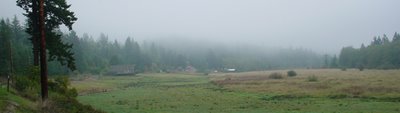
We packed up the canoe and headed out for a paddle on the Duckabush River Delta on the Hood Canal. Fog nestled in the trees and along the mountains and meadows along the way.

It is about a two hour drive to Hoodsport and the Duckabush River, much of it through farmlands, forests and the quaint community along the Hood Canal. This old barn was along a country road, not far from the delta.

The Duckabush River Delta is a critical wetland area managed by the Department of Fish and Wildlife. It is a prime habitat for seals (we saw at least 40), trumpeter swans, and critical fish stocks. As we paddled up the river, we noticed many schools of young salmon, and also the old salmon dying along the riverbottom.
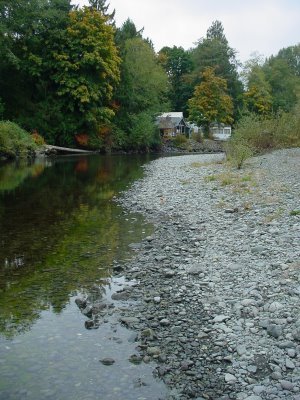
We had to wait for the tides to be just right before we could head upriver, otherwise the low tide makes paddling impossible. George has been wanting to do this paddle for years, but had to wait for the right tides and weather to do it. It is a beautiful, clear river, with little cabins nestled along the edges.

The water was a deep emerald green, and the riverbank was still verdant with ferns, wild roses, and currant. Cars were lined up along the highway, with throngs of fishermen. Access Washington's News Releases at this time last year reported: "Chum are already abundant near the Hoodsport hatchery on Hood Canal, said Mark Cylwick, WDFW hatchery specialist. They began showing up the third week of October. The chum normally peaks just before Thanksgiving. "They're running a little bit early right now, so that indicates we're going to have a giant run or that things might peter out a little early," Cylwick said. He described the chum as semi-dark with some brights mixed in. "Usually the fish are in pretty good shape out here in front of the hatchery because they're still in saltwater." he said. A creel check Oct. 29 on the Hoodsport shore showed 59 anglers with 42 chum. . ."

"This time of year, anglers have to play the weather as well as the fish, Thiesfeld said. They need to hit the rivers when they're high enough to bring in salmon, but not so high that they're unfishable. "This is a typical fall pattern," Thiesfeld said. "You watch the weather and stream gauges. If the rivers drop back into shape, you go. If not, you stay home and watch football or go blackmouth fishing."

This was our 'put in place'. We slid the canoe down the embankment along the left, then paddled for about an hour and a half up-river, then down-river out to the delta. There, we watched seals bobbing in the water. I was able to videotape the vast imagery of the delta, with the fog distant in the trees and the seals barking at us.

We pulled the canoe up onto a grassy bank and found a wild apple tree, just covered in perfect red apples. I emptied my camera box and we shook some of the apples down. We filled the box, and I plan to make a couple of apple pies, and some applesauce.
Feast of Ilm -Knowledge

We held the Feast of Ilm at our home Sunday evening. While everyone was singing "This Little Light of Mine, I'm Gunna Let It Shine", I was outside catching the inner glow of our home. Mordrid, our cat was watching me from his spot on the front porch.

I served light refreshments - spinach quiche; zuchinni boats stuffed with creamed rice and black beans; hummus and pita bread, tomatoes from the garden, and cherry cheesecake pie. That long flower-planter is filled with the apples and quince we picked on our canoeing trip. (Thanks to Taraz for the photo.)

Friday, October 13, 2006

You Rent The Movie - I'll Bring The Treats!

Seen a good movie lately? I've got "Buffalo Boy" a film by Nguyen-Vo Nghiem-Minh; "Osama", Golden Globe Winner 2004 Best Foreign Language Film; and "For the Children", with a review that says, "In the parched desert landscape of northwest China, peasant Meili Zhang founds a school, determined to give her students a chance at a better life. When Yu Xia, a cultured, volunteer teacher from Beijing arrives to help her out, these two women from strikingly different backgrounds discover that they share the same goal: to help a generation of disadvantaged children overcome a legacy of poerty and lost opportunities with the most precious and valuable gift there is: Education. "

Why Dogs Hate People

New Threat Looming Over The Horizon

A public school teacher was arrested today at John F. Kennedy international Airport as he attempted to board a flight while in possession of a ruler, a protractor, a set square, a slide rule and a calculator.

At a morning press conference, Attorney General Alberto Gonzales said he believes the man is a member of the notorious Al-gebra movement. He did not identify the man, who has been charged by the FBI with carrying weapons of math instruction.

"Al-gebra is a problem for us," Gonzales said. "They desire solutions by means and extremes, and sometimes go off on tangents in search of absolute values. They use secret code names like 'x' and 'y' and refer to themselves as 'unknowns', but we have determined they belong to a common denominator of the axis of medieval with coordinates in every country. As the Greek philanderer Isosceles used to say, "There are 3 sides to every triangle."

When asked to comment on the arrest, George W. Bush said, "If God had wanted us to have better weapons of math instruction, He would have given us more fingers and toes." Government Aides told reporters "They could not recall a more intelligent or profound statement by the President."

(thanks to Oldeupher for this little ditty) (Anybody elths still lisping here.....?)

Hazine-ash cheghadr ast?

I've rented one of my favorite videos from the public library - "The Wind Will Carry Us", about a filmmaker from Tehran Iran, who travels to a remote mountain village secretly planning to record a local ritual ceremony surrounding an old dying woman. It is an extraordinarily beautiful film, and the customs and village life are very endearing.

Whilst engaged in my pursuit of far-away places, I just happened to google the mountain ranges of Iran - the Alborz range runing west to east and the Zagross range running northwest to southeast. I wanted to obtain images of the terrain. I recall that when Baha'u'llah, the founder of the Baha'i Faith, was banished from Iran, he and his family had to cross mountain ranges in the middle of winter. It took 3 months to travel from Teheran to Baghdad over rugged mountain passes, and Baha'u'llah's wife was not adequately dressed, nor was she adequately prepared for the journey. Curious, I then researched the type of clothing that women wear in Iran, and found some extraordinarily fashionable examples.

Hejab , the "traditional" Iranian dress code for women requires them to cover their body modestly. But, Iran Travel says a simple pair of socks and a headscarf with a pair of pants and a lose shirt is all one needs. After arrival one can simply buy travel clothes in any shopping mall.

Most Iranian women wear a Manteau (a long or short coat) and headscarf; some still use the chador. Foreign women visitors mostly wear a Manteau or loose knee-length jacket and headscarf. Upon arrival a woman should wear a loose-fitting coat to knee-level. One must dress more conservatively if visiting mosques and religious buildings.

I thought I might share some of the images - I thought they were gorgeous, and I'd love to try them on! But, I suspect they are way out of my price range.

Thursday, October 12, 2006


Leilaye Leili is a Persian blogger with a dream.....here. (Scroll down to the video, it is enchanting and powerful.)

Extending Her Reach

Our daughter Ruhiyyih has a big heart. She looks for outlets for its expression. Its not enough that she planned all of our family celebrations - birthday parties, Christmas celebrations, and camping trips - but, in the process she extended our family. Incrementally, with exuberance and laughter, she brought more members into the family. They came for Thanksgiving, came for sleep-overs and camping trips, and they came from far away - Washington DC., California, and ..... even China. They came bearing gifts which still hang on my wall, and grace picture frames up in my guest room.

A lot of them were guys who found that Ruhiyyih was their first best friend, of the opposite sex. They disclosed all their fears and family history, and their families invited her across the country to spend Christmas with them. Ruhiyyih got to know all their brothers and sisters. She talked to the Mom over the phone when the son was too busy to call.

She found ways to package up care packages for old friends teaching in China, catering to all the rules and regulations. And the oddest assortment of items would be in those packages, things that reminded her friends that home was just as close as a package of Swiss Miss Cocoa or gummy bears, Blueberry poptarts, and HoneyNut Cheerios. When she taught in China, she knew just how much one can miss home.

So, she has her favorite 'friends' far away, people she cares about. And, Ronald is one of these friends. He is in 4th grade, and lives in Kampala, Uganda. Through World Vision she makes sure he has medical care, school books, shoes and uniform, and that his basic needs are met. He writes her letters, which come here first, so that I can enjoy reading them. I forward them to Ruhiyyih. He has written about his performance in school, enclosed artwork, and said that through her support to his family he has been able to buy piglets to improve the family's income level. Maize seeds and bean seeds were distributed for cultivation. Ronald also got his immunizations and HIV/AIDS Awareness education. All of these services upgrade his chances to improve upon his life. Ruhiyyih has sponsored Ronald for over a year now, and looks forward to his monthly correspondence.

She also supports Soldiers Angels.org, an organization dedicated to providing aid and comfort to our military and their families. Soldiers' Angels are dedicated to ensuring that our military know they are loved and supported during and after their deployment. Ruhiyyih mailed a package today, filled with chocolate candy for Halloween, microwavable soups, Crystal Lite for canteens, a Sports Illustrated magazine, and baby wipes. She also writes letters, and stays in touch with the family of the soldier.

A few days ago Ruhiyyih wrote this post on Uganda Lobby Day. She spent a day learning about the conflicts in Uganda, with the hope that lobbing our leaders will help bring about the changes that bring lasting peace to the two million people victimized, displaced, and impoverished by this twenty year ordeal. The most powerful part of the day was when Grace Akallo spoke. She was a former LRA abducted soldier and Ruhiyyih first saw her on the Oprah show. Betty Bigombe, a chief peace mediator, spoke on peace talks. Eunice Reddick spoke on behalf of the US Dept. of State as the Director for East Africa.

Ruhiyyih attended Plenary panels on:"The Human Cost of Crisis: Humanitarian Responses to Conflict in Uganda","Building a Sustainable Peace: Human Rights, Justice and Reconciliation in Uganda", and "International Response to the Crisis in Northern Uganda". She says the symposium was a life-changing event for her.


When Ruhiyyih got home after the Uganda Lobby Day, she sat down at her kitchen table with a friend, who listened to all the details of the symposium. As they finished their cocoa, the friend said, "You are such a good samaritan - I bet you even recycle your garbage." Sure enough, with pick-up in the morning, all Ruhiyyih's plastics, tin cans, glass, cardboard and paper, were set out by the curb.

Wednesday, October 11, 2006

Sunset Out My Window

I've just come in from a long day working out in my yard - cutting down all my perennials. The flowerbeds look so bare, the grass so dry. A few beanpoles show through the window, in the last rays of sunset.

Everyone Has Something To Give

I was reading Rama's post about "Increasing the Quantity of Kindness" wherein he quotes a passage from Theodore Zeldin’s "An Intimate History of Humanity". He offers a story about a murderer and a monk, and the chance encounter between them which would change both their lives forever. Both of them were transformed by choices and the interdependence between them.

Yves, a commenter, wrote: "The story of the murderer reminds me of a thought I never got round to expressing anywhere till now. The worst and most pointless punishment for a convicted criminal is to have no chance to make amends. Here in UK, it's on the news that the prisons are all full. The Lord Chief Justice is advising judges to sentence offenders where possible to community service orders because overcrowded prisons aren't of any use in rehabilitating their populations. If I were running the administration of justice, I would sentence an offender to penance, reparation and expiation. They should play a part in designing their own projects to achieve these objectives, and in some cases the projects would last for many years. All punishment should be motivated by kindness."

Rama responded with: "...prisons and how crminals are treated - remains the great un-addressed question of our times. But some efforts are on in different parts of the world to do something different. Imprisoned criminals, motivated by expiation and reparation - could also be seen as a valuable resource in society. Perhaps one day, such a view will be more widely shared, esp by govts and prison administrations."


This discourse reminded me of my mother-in-law, Alberta, who lay bedridden in old age. She spent hours every day making phone calls from her bed, soliciting money from organizations that could help free unjustly-held prisoners in foreign countries, like Guatemala, Honduras, and Nicaragua, etc. She raised thousands of dollars yearly, yet she was housebound, like a solitary prisoner. I often thought it a paradox, that she would devote the waning strength of her life to helping those unjustly imprisoned, and yet here she was, rarely able to go outside because of allergies and serious breathing issues. It made me realize that those who 'know' what something feels like, step up. They want to make a difference in someone elses life, in outcomes.

Rama wrote, "It is in the power of everybody, with a little courage, to hold out a hand to someone different, to listen, and to attempt to increase, even by a tiny amount, the quantity of kindness and humanity in the world. But it is careless to do so without remembering how previous efforts have failed, and how it has never been possible to predict for certain how a human being will behave. History, with its endless procession of passers-by, most of whose encounters have been missed opportunities, has so far been largely a chronicle of ability gone to waste. But next time two people meet, the result could be different. That is the origin of anxiety, but also of hope, and hope is the origin of humanity."

Alberta surely started every day with hope, with the optimism that she could make a difference for someone that could not speak or act on their own behalf. Looking at her, you'd hardly know she had so much persu- asiveness and power, as she was quite modest and soft-spoken. She was often dressed in a simple bathrobe over a pair of rayon slacks. She'd lay on her bed, papers and phone lists organized on the coverlet, and her phone nearby. Over the years, she became quite well known in the Tucson, Arizona area, and friends and peace-activists were always welcome at her door.

She is shown here with Ruhullah and Ruhiyyih during a family visit . She knitted mittens, sweaters and scarves for them, knit quilts for their beds, and sent project materials at Christmas-time, so they would have fun things to do Here, the kids are showing their drawings while "Grandma" is holding her box of materials. Our kids don't remember their grandma as a peace activist. They know she just hand-made every gift they ever received.

Tuesday, October 10, 2006

And, So It Goes, These Friends

This photo shows two old friends of mine, Carol and Bill Spell. They purchased property many years ago near McKenna, which has been turned into "Brighton Creek Conference Center". It is a huge rural property, with a stream running through it, boarderd by a chicken farm and horses, hay fields and forest.

The first time I came here, I camped out for a weekend with all my kids, to attend an Arts Festival. Yearly there are salmon bakes, seminars, and festivals. This weekend, the yearly Baha'i 'District 157' Convention was held on Sunday. George drove out early to set up the music, and I drove out later, bringing two friends along, BJ and Judith. This was the first time I've ever driven there - usually I'm a passenger, enjoying the scenery. But, I took a long straight-shot, along Pacific Highway, turned at a flashing light about 20 miles down the road, and turned into the Conference Center, much relieved that I had found it with BJ's help.

The reason I write about driving to this confer- ence, is that I have great difficulty driving on freeways, or out to unfamiliar places. I lose my way easily because of a poor sense of direction. And, my vision is getting worse - my periferal vision is gone, and long distance vision is compromised. When the Conference was over, and it was time to drive home, I really had to 'work', to drive carefully. I realized that speeds over 35 miles per hour are harder for me, as I'm not used to driving any faster than this. I averaged 50 miles per hour most of the time, and fortunately that was the speed limit! I realized, also, that when people are in the car holding deep conver- sations with a lot of details, I can 'space out', and lose my focus on the road because I'm processing their comments - that really compromises safety. I had to work hard to just drive safely, slowly, and keep my wits about me. I felt at a real disadvantage, like I have some kind of acquired imparment due to 'not enough practice' and changes associated with aging. Now I realize why older people drive slowly, why they stare straight ahead, why their reactions are slower.

This all relates to a topic that was brought up at the Conference by a Baha'i who is disabled, and uses a mobile scooter-chair to get around. Joy addressed her concerns for handicapped-accessibility features in the bathroom and dining hall at the conference center - mainly more room for turning her machine around. She also asked to be accommodated during our voting for the Baha'i delegate, by allowing drive-up access to the ballot box to process her vote.

It was interesting listening to her talk about the struggle to access buildings, ride busses, and be included in community functions because of her handicap. This prompted memories of Baha'i Conventions I've attended over the years, at least 40 of them, in Montana, Washington, and Illinois. The Montana Conventions (State) stood out in my mind. Back then, we never thought twice about driving for 6 hours to go to a meeting. Always, the convention was held in Helena, in the middle of the state, and it was our job to figure out how to get there, whether it took all morning, or longer. Sometimes there was terrible weather, sometimes snow! We just packed food, warm clothes, and spent hours driving, looking forward to visiting with all of our old friends from across the state - the Saunders, the Bennetts, the Merenesses, and about 50 other families. The Montana Baha'is went to cast a vote at an election, crossing vast expanses of prairie, and to engage in consultation about the growth of the Baha'i community.

Not much has changed in 40 years. I'm still amazed. Although the Montana Baha'i community included Baha'is from all over the state, and ours involved only a district within Washington state, it still felt the same: intimate, a small gathering of about 100 people. There are always a few new faces, but always there are people that show up year after year, like homing pigeons, returning to bring the same spirit and love that are such a significant part of their personality. I told George, that they are like a little floating patch of bubbles in a stream. As it floats along, tumbling and turning into little eddies and into swift current, parts fall away never to be seen again, and other bubbles catch hold, hang on, and glide along for the ride. Especially valued are people who seem to provide a strong core, reaching out to help everyone hold on. They are like a glue, and they play very significant roles, guiding, supporting, and inspiring. Every religious community has them, whether Moslem, Jew, or Christian.

This is Erika, a guest from our National Center, who lead some dynamic discussion, and talked about growing up "as the only Baha'i youth" in her community (I felt that way too being the only Baha'i at the University of Montana in 1965.). She said that over the years, as growth spurts occurred, "we all cut our teeth on each other" - her way of saying, growing means struggle and pain, revising and correcting mistakes. She talked about the core activities of the Baha'i community - childrens classes, devotional meetings, study circles and home visits where Baha'is share their faith with others who have asked for information.

These are a few of the Baha'is at our con- vention, which had a children's program, music, an hour lunch for visiting old friends, and consultation.

This woman is Persian. Her daughter and son-in-law sat next to me during the convention.

This is Jay and Christine, who have attended our study circle.

Taraz and Megan lead the classes for pre-youth, who put on a perfor- mance, singing prayers and making prayer beads.The conference ended with a story about man's ego. The story describes a community that decides that after learning how to clone humans, they decide they no longer need God. They can live alone now that they can make themselves. So they visit God, and tell him that they don't need him, and he tells them to do an experiment. He says, "Lets have a contest. I'll make a man, and you make a man. We'll see how quickly it can be done." He reaches down for a handful of mud, and starts to build, patting the mud into the shape of a man. The men each see how easily he does it, and reach down for a handful of mud too. That's when God stopped them and said, "Get your own mud."

A Cloud of Smoke - By Robert Genn

A week ago, author and aircraft expert Wayne Ralph interrupted my painting by dropping by with a book. "A Distinguished Old Bentley Drove Down to the Sea," was not your typical gift from one artist to another. A children's illustrated poem, "suitable for 4 to 6 year olds," I figured he gave it to me because he'd seen me driving around in my '38 Bentley--and just in case we ever have any grandchildren around here. I leaned the book against a pile of half-finished canvases and didn't look at it until this morning.

You can read the whole thing, out loud, in two minutes. It's about an old Bentley who was not feeling too good about himself, who went for a drive and parked out on a pier. While he was bemoaning the state of his sparkplugs, a humpback whale passed by and heard Bentley humming a song. The whale was also having personal problems.

"My daughter had twins in the last hurricane, And my son wants to marry a lobster from Maine."

The whale is encouraged by Bentley's song. Thinking things over, the whale heads off with a splash to look after his family, while Bentley realizes he's been a benefit to the whale. Bentley concludes, "I like being me," and backs down the pier and drives off in a cloud of contented smoke.

I admit it, every time I paint a picture--or write my twice-weekly letter--I'm thinking that something in what I do might bring value to another person. I believe that reaching out and connecting with others may just happen to be our highest calling. In the regular inflow of emails, many artists tell me that they don't paint to please anyone but themselves. A lot of this attitude, while commendable in some ways, is a cloud of smoke.

It's my observation that all of us, no matter how iconoclastic and independent, while looking to our own sparkplugs, also keep our eyes on connectivity. I don't know how you feel about it, but I think universal love gets into art, too. Without connectivity in our lives there's no reason to keep our sparkplugs sparking. It's not a difficult plot.

"Here I've been thinking how everything's wrong, And yet I've encouraged that whale with my song." (Lisa Rae)

Esoterica: In the palliative care unit of our local hospital there are several large works painted and donated by my daughter Sara Genn. They depict little people floating around in space, variously connecting and disconnecting with one another. Hardly a month goes by without someone phoning me and mentioning they have seen these works. On green-painted walls of stress and sadness, Sara's paintings bring a smile or a chuckle to patients and visitors as they come and go. While art may inform, challenge and teach, it also helps people feel good about themselves. In the final tally, this may be its ultimate use.


(And, more here from Fragments From Floyd, a wonderful writer who addresses another type of connection, that of the senses at night in the forest....)

Monday, October 09, 2006

Anderson Landing and Mission Lake

This is an algae bog in an old growth forest in Kitsap County.


On Saturday we hiked through this forest to get to tideflats below Anderson Landing, in Kitsap County.

There was a 'seldom used' trail, replete with fallen leaves, mossy rocks, 5 inch slugs, and oodles of cobwebs extending from one side of the trail over to the other - and of course I led the way, brushing the thin whisps off my face as we went along. However, any spider spinning trails over 5 feet 4 inches tall lost his efforts when George walked by. He got his face full too.

We hiked for about 40 minutes on a fairly steep trail down to the water, then arrived at an open area, pictured here, strewn with oysters and mussel shells. A freshwater spring emptied into this bay. Those are the Olympic Mountains in the background.

The day started out gorgeous and sunny, perfect for hiking and exploring. When we finished, we decided to canoe Mission Lake, which is nearby. It is a little lake, with quaint cabins and nicely maintained homes. There is a fishing-boating ramp that made it easy to unload the canoe.

This photo shows the far end of the lake, which is more remote, and boggy. Wildlife enthusiasts have placed nesting houses for large birds along the shoreline. I was surprised to see wild aquatic lobelia still in bloom, a bright yellow. A few large grey dragonflies hovered alongside us. It is uncommon to see them this time of year when it gets chilly.

As George unloaded the canoe, these two fishermen told me that this was their first time fishing in Washington state. They are from Arkansas, serve in the Navy, and work on the aircraft carrier the 'John C. Stennis'. They didn't know where to fish, so they bought a book about fishing in Washington, with more than 1,600 locations featured - rivers, lakes, streams, reservoirs, estuaries, and coastal stretches open to anglers, regardless of their preferred tackle and technique. The author, Terry Rudnick "covers it all, from the fly-fishing-only steelhead streams of the Olympic Peninsula to deep-water trolling for giant sturgeon in the Columbia. Driving directions, fish species, regulations, preferred flies and lures, and fishing conditions are all covered for each body of water." One of the young men showed me the book, saying they'd been out since early morning, without much luck.

From the shore, it is not easy to catch large fish, and lures and bait get stuck in the water. I told them about float tubes that I've seen fly fishermen use. The device enables the fisherman to walk further out into the water, floating as he goes along, to get a better vantage point. Nifty little pockets and rod holders are attached to the floating tubes, and there are places to hold beverages.

To stay completely dry, waders are used, which completely cover the legs and torso. These protect against hypothermia, guard the legs against abrasions, and prevent little critters, like parasites, from burrowing into the skin.

Long underwear can be used under the waders, and pocket warmers can be placed inside, near the feet. I've got these warmers in my backpack, for emergencies.


But, back to our glide: Mission Lake took about an hour of easy paddling, with little twists and turns that made it interesting. I like the charm of older cabins, nestled in the woods. One of the surprising features of this lake were the platforms, or docks, that were blown away from people's property, and were found stuck elsewhere, often left to rot unattended and unused. Little shrubs and trees protruded from between the boards and styrofoam, creating little meditations. These often become sunning platforms for Canadian geese and mallards, who frequent the area.

This is a large piece of styrofoam stuck between submerged logs. It's a 'nurse-log' for nesting aquatic plants. Parts of this had been chewed off by beavers, who had a dam at the end of the lake. Submerged logs are always the most dangerous part of canoeing a small lake like this, and the tannins in Mission Lake made the water very dark. It was difficult to see the logs.

Our paddle was quite delightful, and was a refreshing way to end the day.

Friday, October 06, 2006

Roots - Hoh Rain Forest

The Hoh Rain Forest is in the Olympic National Park, and has about 150 inches of annual rainfall a year. Megan took this image of Taraz on their honeymoon a few weeks ago, and I stole it from Taraz's blog, which is listed on my sidebar.

I've been tagged by Gangadhar to list 8 things about myself, and if I give it much thought I will probably stall and not do it, out of sheer fright of 'exposure'! But, I just had a cup of coffee, and I'm revved up, so here goes....stuff that just enters my mind:

1. I'm constantly pondering human nature, its current definition and its possibilities and its limitations. All over the world I see the effects of poverty and injustice, and I wonder if we are stuck with an abysmal sense of human worth. Because if we thought and lived better, we'd upgrade what it meant to be human.

2. I would prefer to live in the country, so that when I wake up in the morning there is just a vast image of pastoral beauty. Snow-capped mountains are great, and so is a bubbling stream, and deer in a meadow. (Bucolic fantasies, shaped in childhood. ) I now live in a 'working class town', a city that is a sister to Seattle, with its cargo ships and shipyards, its wonderful mix of cultures and ethnicities. When I grew up in Montana, Indians were the only other race, and they were so marginalized we never saw them. When I was young, I never questioned that.

3. I enjoy going for daily walks through the campus of the University of Puget Sound, so that I can listen to the conversations of the students as they pass me on the walkway. I walk along in a T-shirt, jeans, and hiking boots, and the girls who pass wear little shirts with thin straps, with indeterminate waistlines, with each layer hitting a different belly-mark, showing skin and a summer tan. These girls seem totally distracted by the man-woman thing to have any comprehension of acadamics and life in the world. They sit on the grass and preen, like turkeys, and hope that the boys throwing the football on the commons will glance their way. They have a book on their lap, but talk with great animation on their cell-phone, about alcohol and a party on the weekend. I don't think things have changed much in the past 40 years with these young folk on campus - just the props are different. I feel sorry for them, for the limitations that they experience. It will get better.

4. Politics has always been difficult for me to comprehend. It always seems more theatrical than prudent and effective. I am appalled at the partisan divisions that create so much strife and backbitting, which ultimately delay real progress. I also have to admit my own intellectual limitations - there is much that my mind simply can't contain. It's all too complicated, a network of impared relationships and poor communication....all in need of massive cleaning up so that some real work can get done. I hope this happens someday.

5. My mind 'drops' information that I wish it would keep, because it could be useful later. Like names - I have a hard time remembering the names of some of the residents I took care of when I worked as a caregiver. Frequently I'll remember them, with the greatest fondness, and doggone-it if I can't remember their name. I'll remember bathing them, dressing them, organizing their closet - even remember all their habits - but, I'll not remember their name. Sometimes, I imagine the gates of Heaven are lined with these old ones, and when I arrive I'd like to be able to say, "Hi Dorothy!", "There you are, Shirley". You see if I can't remember their name, they might think they weren't important to me - and they were.

6. I have enormous difficulty with small-talk, or extended language on anything (even writing). Growing up, out in Montana, I greatly appreciate the succinct language and writing of the ranchers there - like words spoken during a windstorm or snowstorm, shouted across vast distances. They keep it simple, unflourished, unpretentious - "storm's comin' up". Those few words conjur up all kinds of stuff that has to be processed privately, quickly. No time for more words. Everyone will be thinking about the work they have to do, and how to get it done. I also love the dialogue of children, for the same reasons. (And, the simple dialogue in "The Color Purple", where the language fits the character, Celie, making her so real.)

7. I would like to see history written in the context of 'spirit' and 'human evolution', not just territorial disputes and wars and politics. That part of history is tedius, and I forgot all the details of who won what war due to what grievance. When I was in high school, taking world history, I just loved map-making, the migrations and settlements, the rise of civilization in Mesopotamia, and the new inventions making communication and travel so easy. I wondered what is ahead for all of us and how does one prepare children for the greater world, a world filled with so much conflict and violence. One of my concerns is language, how it is used, and the impact it has. Some day I think a book will be written on how we perpetuate 'poor practices' due to poor communication skills. Good communication will be one of the challenges when we attempt to promote global collaboration in order to improve people's lives.


8. And, of course, all of you know by now that I cherish seeing my children, listening to them, watching them, being with them. They are all sooooooo different, like desserts. Ruhu'llah could be lemon merangue pie; Ruhiyyih, apple pie; Laurel, chocolate cream; Taraz, pumpkin; and Rahmat, pecan pie! All of them, my favorite! And, those flavors do fit them, they know why.

Thursday, October 05, 2006

Just got this in an e-mail from my sister, Bonnie (Bubbie Dear). This is where they were hiking last weekend, up in Glacier Park, Montana. What a gorgeous place to spend a day!


It's a post-modern world....imagine
this, featuring Ghandi. (thanks to Rama for the link)

Family Gathering - Rue's Birthday

Our son Ruhu'llah turned 29, and his wife Annie threw a party for the family - her parents, Tim and Kathy; her grandmother and brother; her close friend Hannah and son Gabe; George and I; Rahmat; and Taraz and Megan....and of course our grand-daughter Daisy.

Annie made lemon merangue pie - one of my favorites, and served chicken, chips, grapes and canteloupe. Rue opened his gifts, and read his cards.

Although I have a few photos here, my camera couldn't present an image for me to see in the viewfinder because of the low light. So all my photos were 'guesswork', and most didn't turn out. You'll have to visit Annie's blog - she's got the good camera!

When families get together, they bring up old stories that cause us to count our blessings. George brought up an old memory, something that happened 20 years ago, when Rue was nine. We were living in Montana at the time.

Rue was riding his bike, went to stop at a busy street, and his brakes failed. He was hit by a truck with a cattleguard on the front, and that probably saved his life. The cattleguard flipped him up over the hood and across it. He sustained a fractured hip and a head injury, and was in a coma for two weeks.

During that time, we read stories and jokes to him, just in case he could hear us. We wanted him to know that he was loved, and that we were near. When he would groan, we never knew if it was because he was in pain or because the joke was bad.

Someone was with him everyday. When he awoke from the coma and eventually came home, he refused to use his wheelchair, insisting instead on his own method of learning to walk again - by holding onto walls and feeling his way along.

It was several years recovering from the head injury. He was extremely sensitive to noise and stress, and had difficulty learning in school, getting assignments done on time. I recall I had to help him every night, to stay on task. By the end of the school year he had completed all his assignments - weeks of makeup work, painstakingly prepared.

His bike was demolished in the accident, and his class held a bake sale and bought a new bike and helmet for him. He got back on his bike and started tearing around the neighborhood again, almost proud of the scars and the wounds he had.

Today, he is robust and strong, enjoys snowboarding in winter, and works out to build his strength. He is a wiz at economics and money management, taking coursework in mortgage lending in addition to his job in management at Fred Meyer. When I look at him, I'm so grateful that he doesn't step down from a challenge, that he works to stay healthy and strong.

If only I could have seen this night 20 years ago, and been comforted by the images that I see today. Often, in the thick of things, when times are tough, we think life will remain clouded with hardship and suffering. But, better days always present themselves, in time.

On the way home I pointed out that in the last year there has been a birth (little Gabe), a marriage (Taraz and Megan), and the loss of two husbands - Annie's grandpa Covington, and Hannah's young husband Gabriel, who was killed in Iraq in August. So many changes, losses and gains.

This photo is of little Gabe, who will carry on his father's name. Rue held him often, enjoying his cheerful disposition.

Wednesday, October 04, 2006

This is an image of an Afghan boy flying a kite in Kabul, where the sport of flying kites is a popular winter pastime. It is also a significant theme of the book "The Kite Runner" by Khaled Hosseini. I bought the book last week, and find it to be beautifully written, poignant, and invested with many details of Afghan life.

I get a book like this so I can get lost in the story. It is a work of fiction. I read it very slowly, to savor nuiances and feelings. It is the story of two boys, one a servant to the other, and of their coming of age just before the revolution and the invasion by Russian forces. The author conveys how the Afghan people struggle over the forces of violence - forces that continue to threaten them to this day.

The metaphor of the kite runner predominates in the story - that sport of flying homemade kites, in competition, flying the kites into one another, cutting the strings of the other contestants, and bringing their kites down. The last kite left is the winner, and all the children run to catch the other kites as they drop from the sky. This sport is a national pastime, like our football. During the years of the Taliban it was outlawed because so many children would become injured or killed, falling off roofs and out of trees, in their attempt to catch the falling kites, which are like a trophy.

While I read a book like this, I research images on the internet, to provide context. I want to see landscapes, the markets and communities, the clothing. I go off on tangents, reading private journals of artists who explore the area and share their photographs. One such artist is Alexander Merkushev, from Russia, who traveled through Afghanistan on three trips as a television producer covering the conflict between the Taliban and the Northern Alliance. His work can be found here, with excellent photographs and a review of his experiences. I especially enjoyed 'street life' and the portfolio on women and children.

Over the past 20 years I've spent most of my time reading books while holding a yellow marker, or a pencil for underlining. It was information I was after, and most books were non-fiction. "The Kite Runner" is the first book of fiction I've read in a long time, yet it fits in the category of 'a personal narrative', like many of the non-fiction books I've read. I'm drawn to sparce environments, like the tundra of Alaska, the vast western prairies, the high steppes of Tibet, and the raw elemental environments of Afghanistan. The journey causes me to marvel at the skills of people living in harsh places, where just the basics are an every day contest for survival. When I stop reading, look around, and see the differences in lifestyle, I can see advantages to my lifestyle, but also disadvantages.

Questions arise: What are the metaphors for spiritual survival? How are they played out, and what shape do they take. What is the flavor of the language and how well is it used? And, how will I feel when I finally close the book. Will I feel like I've been drawn into a private world as a privileged guest?

Another link on kite flying in Asia at Planet-Kite....

Tuesday, October 03, 2006

Mercer Slough Near Bellevue, Washington

Taraz and Megan joined us for a paddle on Mercer Slough right in the middle of one of Seattle's major suburbs. It is amazing to find such a delightful, intimate waterway right in the middle of a major city!

As they paddled ahead of us, we had to negotiate paddling under viaducts and overhead freeways, replete with the sounds of abundant traffic overhead. But, once past these, the slough meanders through a quiet forest dotted with sprawling corporate offices. All of the office windows were floor to ceiling, with desks, computers, and filing cabnets organized into little cubicles. I imagined that if I worked there, I'd be looking out of the window most of the time, wishing I was gliding along on the water.

Walking trails lined the parkway, and large expanses of grass separated one building from another. A thicket of brush - mostly blackberry canes - lined the shoreline, so very few places offered a path down to the water. We enjoyed seeing large turtles sunning themselves on logs along the shoreline. They'd drop down off the log as we approached. mallards floated alongside us, as they have become used to people frequenting the area, so do not scurry away.

This paddle is the first of many we hope to have with Taraz and Megan. It was fun to watch how they work 'their system' in tandem, pulling the canoe through the water and maneuvering around obstacles. They have a little practice ahead of them, which will hopefully damper Taraz's eagerness and enthusiasm, so he does not paddle so animatedly! He places four strokes to Megan's one very carefully placed stroke, and he has a penchant for racing. But, then, we do too, and we cut him off and won......even with George doing all the paddling, and me filming the event!

I told Taraz that he will build up the muscles in his arms and chest after he's done a few years of paddling. And, I warned Megan to be careful about portaging long distances over the years. It can take it's toll on the cartilege in the neck and shoulders. George and I were caught in a storm a couple of years ago, and the wind forced us out of the water. It started raining, and we had to portage our canoe about a mile around the lake on a trail, rather than paddle. We dragged the canoe part way too. That was my last 'over the head' portage. It caused some compression issues, and it's taken me a couple of years to work out the pain and improve the range of motion to my neck. Of course, I was 60 at the time, and should have been more careful, perhaps just waiting out the storm with an improvised shelter until the wind and rain stopped. But, we were in the San Juan Islands, and had a ferry to catch on our way home, and could not dither away the time.

Naturally, it was fun to watch Megan and Taraz, and to imagine the enjoyment they will have in the future with their canoe. Megan has received certification in canoeing courses at the Maxwell School up in Canada. This is a comfort to me, as I know she is going to have her hands full taming Taraz's zeal, making his strokes count. We were pleased to see her occupying the position at the rear of the canoe, the power position, as from that location she can correct any maneuver made by Taraz up in the front. He, however, is responsible for steering, for ascertaining submerged hazards, and must learn to hold his balance in rough water, compensating for sudden changes. This demands a lot of focus and vigilance.

All of us went to Cascade Water Sports in Bellevue, where George and I purchased our canoe 7 years ago, and we ordered a green Adirondak canoe for them from Wenonah, one just like ours. The man who helped us was on an Olympic canoeing team several years ago, and knows his gear. He pointed out the importance of getting canoes that were similar if we planned to canoe together, that way everyone goes at a fairly uniform speed and stay together. Some canoes are so heavy they do not go fast, even if they are smaller. The Adirondak has a reputation for speed, to cover a lot of ground easily, and that makes it an excellent touring canoe. The tough-weave fiberglass fiber is durable and light, easy for portaging and lifting. It is also very stable on the water, with very little give in turbulent water. We wanted to purchase something that would be very reliable, but also guarantee 'easy paddling', so it doesn't become a chore. Often, this can be the pitfall of some canoes - the inexpensive kind bought at Costco can ultimately become a chore to paddle and load. A few trials on that type, and many owners give up on canoes. They switch to kayaking with ultra light types or the inflatables. (The photo here is of kayaks. All of the canoes were indoors.)

Puget Sound has abundant water courses, with all kinds of water - saltwater estuaries, lakes, and rivers. These are just waiting for Taraz and Megan, and I hope they will have hundreds of adventures, just like George and I, with canoe camping and daytrips, and with hiking side-trips. I'm so happy for them. I think they are off to a good start!

Monday, October 02, 2006

The Skokomish River Delta on the Hood Canal

Our paddle at the Skokomish River Delta occurred at very high tide on a heavily overcast day. That made for smooth gliding over still water. It was a great paddle because of the intimacy of the channel, the meandering pathways upriver, and the drama of the delta, with its resident seal population and shorebirds. The Hood Canal has transient killer whales that come in for the seals every year.

This area on the Hood Canal is stressed due to poorly dissolved oxygen content in the water (hypoxia), and that impacts on the fish and the mammals that inhabit the water. Studies are in progress to determine what has caused the poor oxygen levels, whether due to chum salmon carcasses from commercial fisheries or due to toxins from shoreline residences. There is a neighborhood program that alerts homeowners to proper sewage and garbage removal practices, so toxins will not enter the water.

While we glided along, we noticed that salmon carcases floated in the water, due to the end of spawning. These were some huge fish, some over 3 feet long, with gaping mouths and mottled skin. Skeletons lay on the bottom of the water, picked completely clean, and a few returning salmon glided under our canoe as we headed upriver. They move very slow and have no instinct for self-preservation as they continue upriver. There is something sad and solitary about them, so ragged and spent. One has to imagine the grand life they once lived as they migrated out to the ocean to fulfill their life cycle.

The tribal fishermen had gill nets along the shoreline, most of them emptied and pulled into a pile along the shore. We noticed one large gill-net that still had trapped dead salmon caught in the lines. Sediment had covered parts of them, as if the net had not been pulled in a long time. Little shelters - camps - lined parts of the shoreline, where families had spent part of the summer pulling in fish. Tarps were spread over poles, and buckets, old clothes, and tincans still remained in camp. Fishline, with bobbins and lures hung from snags on overhead branches and also swayed down under the water where they'd been hooked on submerged debris. There is the impression that this area is busy during the fishing season. Yet now it was just filled with fellow kayakers and canoeists, who give scant attention to the ecosystem and the economy built into the area. They just want to explore and appreciat the scenery.
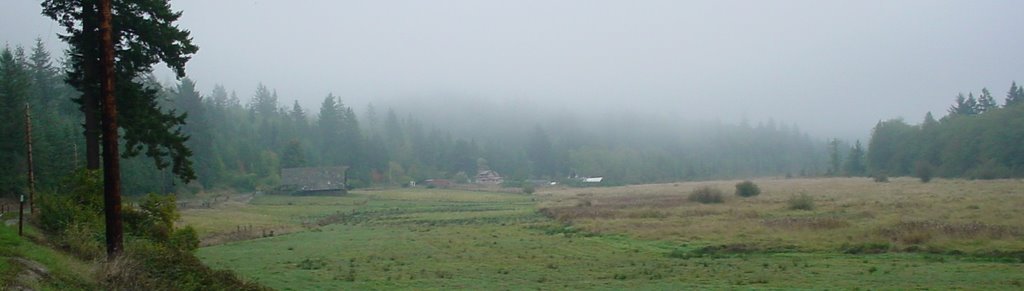
This is a line of birch trees along private property, perhaps to hold in the riverbank. Rarely do you see this type of maintenance along this waterway, as everything is left in its natural state, with an abundance of wild rose and other flowering shrubs. As we paddled along, we noticed old apple and pear trees along the riverbank, and stands of blackberry and current.

And this is one of the little cabins along the entrance to the delta, near our put-in place. It is on pilings, extending up over the water during high tide.

This is my trusty paddler and traveling companion, who raids my goodie box filled with cashews, pretzels, and graham crackers. However, he is also most considerate of wildlife. When I say 'lets get closer', he always stays at a safe distance. When I wanted to get closer to a gathering of sea lions and seals basking in the sun on a sandbank, he refused. Too dangerous and invasive, he said. However, I filmed them with a zoom lens, and watched them bobbing up and down in the water - about 30 of them checking us out. Then, there was a barrage of loud splashes where the sea lions banged the water, letting us know to stay away - or else! They made the deepest growling sounds, and we knew to keep on paddling.